




Scroll
Just Results, Just Reviews
Rated on
REVIEWS

100% success rate
 Verified profile


The free Shopping audit
- A founder-recorded Loom walking through your Merchant Center diagnostics: disapprovals, limited-visibility items, and feed attribute gaps.
- A campaign role check: where Performance Max is eating Standard Shopping data, and where the two overlap on the same SKUs.
- A product-level spend read: which items take budget and return nothing, and which earners are starved.
- Three fixes ranked by expected margin impact, not by effort.
JustLeadMarket is a Google Shopping agency for ecommerce stores in the United States and United Kingdom. The service manages Shopping ads end to end: Merchant Center and product feed health, Standard Shopping and Performance Max campaign structure, and product-level budget allocation based on contribution margin. Feed work is included in management, not sold as an add-on. Budgets are set per product tier from break-even ROAS on the store's own margins, using the Hero, Sidekick, and Ghost classification and the BE-ROAS Budget Map. Pricing is published below, starting at $997 per month, month to month with a 30-day exit. The audit is free and founder-recorded.
Who this page is for
Shopify and DTC stores where Shopping spend outgrew supervision
PMax reports a blended number, nobody has looked at product-level returns in months, and the feed was last touched at launch.
Stores with disapprovals or limited-visibility products
Merchant Center says items are active. The impression data says otherwise. That gap is usually feed attributes, not bids.
High-AOV catalogs
Beds, furniture, vehicle graphics, equipment. A few product lines carry the account and deserve their own campaigns, budgets, and targets.
UK retailers on Google Shopping
Most of our client base trades in the UK. Same team runs both markets natively.
What Google Shopping management covers
Shopping ads have no keywords. Google reads your product feed, matches products to queries, and decides what shows. So the feed is the targeting, and Shopping management is really three connected jobs.
The feed
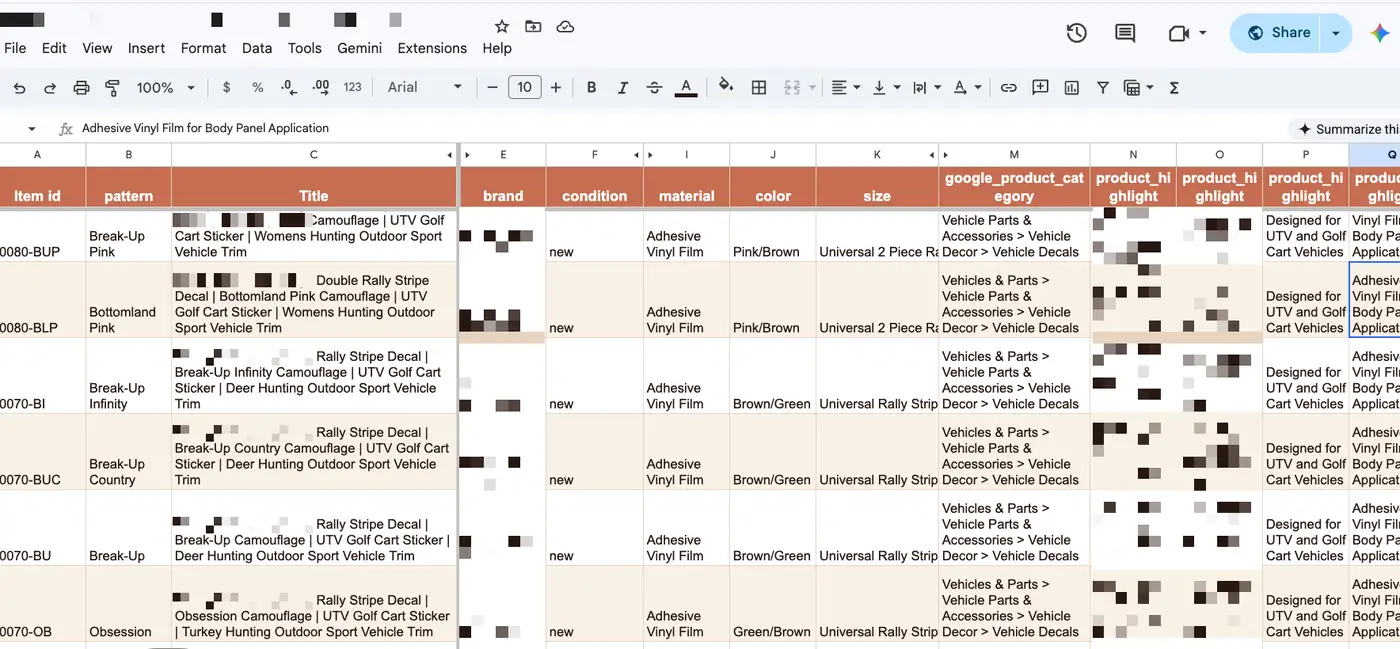
Titles, product types, GTINs, images, price and availability sync, and the attributes that decide which queries you enter. Most agencies treat this as someone else's problem. We treat it as the first lever, because it is.
The campaigns
Structure that separates brand from non-brand, isolates what matters, and keeps priority settings and negatives doing real work. Standard Shopping, Performance Max, or both, each with a defined job.
The budget
Product-level allocation. Every catalog has products that print, products that break even, and products that quietly drain spend. Treating them equally is the default setting and the most expensive one.
One team has to run all three, because each one caps the other two.
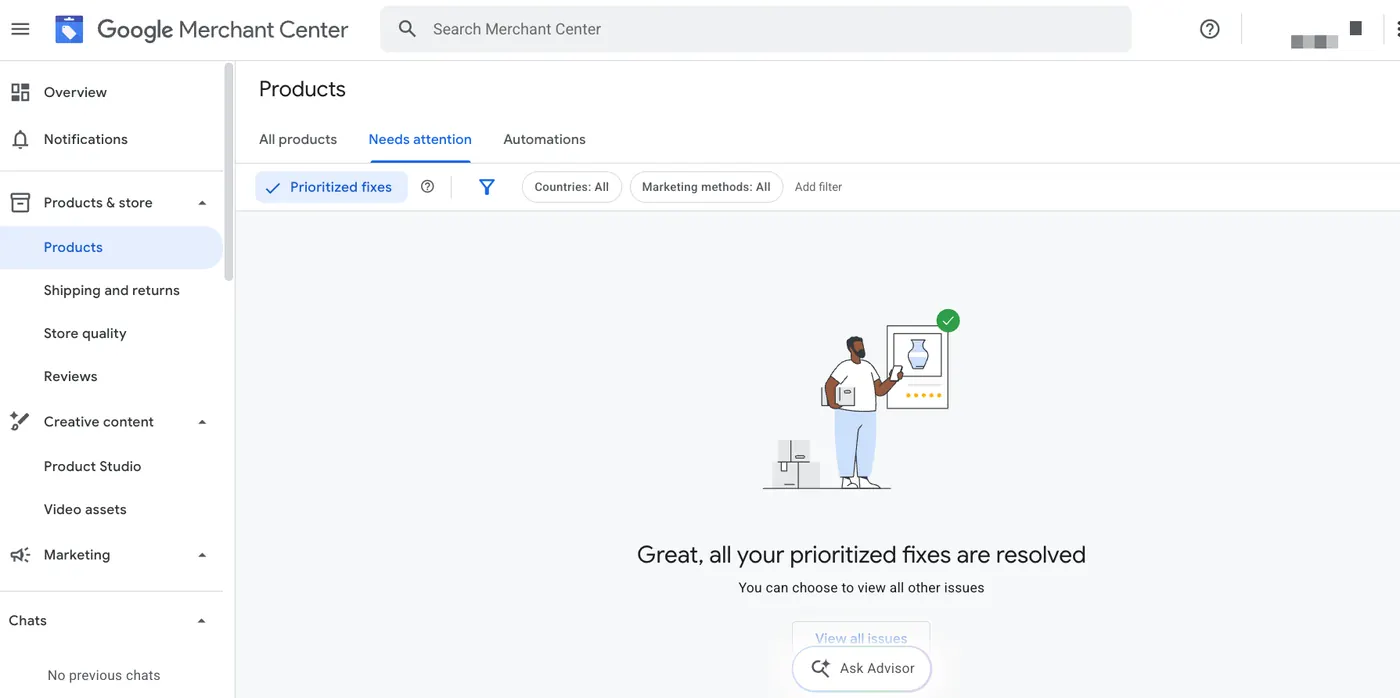
Why we start in Merchant Center
Campaign settings get the blame. The feed usually holds the answer.
In one US gifting account we audited, the product export showed 1,358 products marked not eligible, most with no campaign advertising them at all, while Shopping spend returned roughly $0.17 per dollar. Numbers from a 125-day export ending February 26, 2026. The account did not need braver bidding. It needed feed eligibility, product matching, and structure fixed before another dollar went in.
That is the pattern, so the first two weeks of every engagement run the same checks:
- Merchant Center diagnostics: disapprovals, warnings, and limited items, with the actual attribute causing each.
- Title coverage: whether titles carry the query patterns buyers use, in the first 70 characters that Shopping placements display.
- Price, availability, and landing page consistency between feed and site, the usual misrepresentation triggers.
- Feed rules and supplemental feeds, so fixes survive the next sync instead of being overwritten.
The title checks run against our free Merchant Center title strategy worksheet.
We did this work for a UK luxury beds retailer and a US supplement store, where policy-safe wording and label-accurate attributes decided whether products could serve at all. Feed accuracy is included in management here. It is not an upsell.
Standard Shopping and Performance Max, separated on purpose
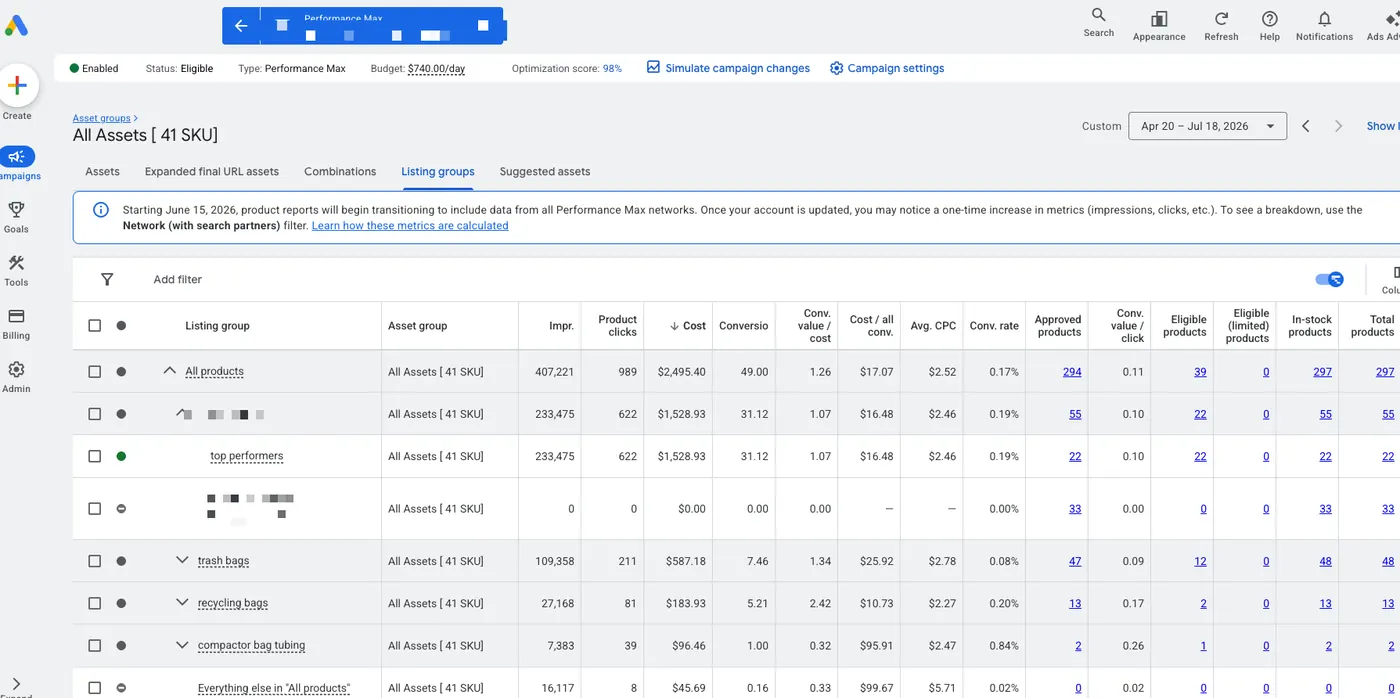
Most accounts we open run one PMax campaign holding the entire catalog. It reports one blended number, spends where it likes, and hides which products, queries, and placements did the work. The fix is not choosing a side. It is role separation.
| Standard Shopping | Performance Max | |
|---|---|---|
| Best job | Control and clean data on proven products | Reach and automation across channels |
| Query visibility | Full search terms | Limited insight |
| Product control | Priority tiers, exact bids, negatives | Asset group signals |
| Where we use it | High-AOV lines, testing, brand and non-brand splits | Scaling winners, remarketing surface |
| Risk if used alone | Slower reach | Blended reporting, cannibalized queries |
On a US vehicle graphics account we reviewed whether PMax was getting real Shopping exposure or behaving like a Search campaign, then decided SKU by SKU which products PMax should keep and which belonged in Standard Shopping where the data stays readable. Exclusions do the separating: a product should have one owner, one budget, one target.
Budget follows margin, product by product
A blended ROAS target is a decision to overspend on weak products and starve strong ones. We allocate at the product level instead.
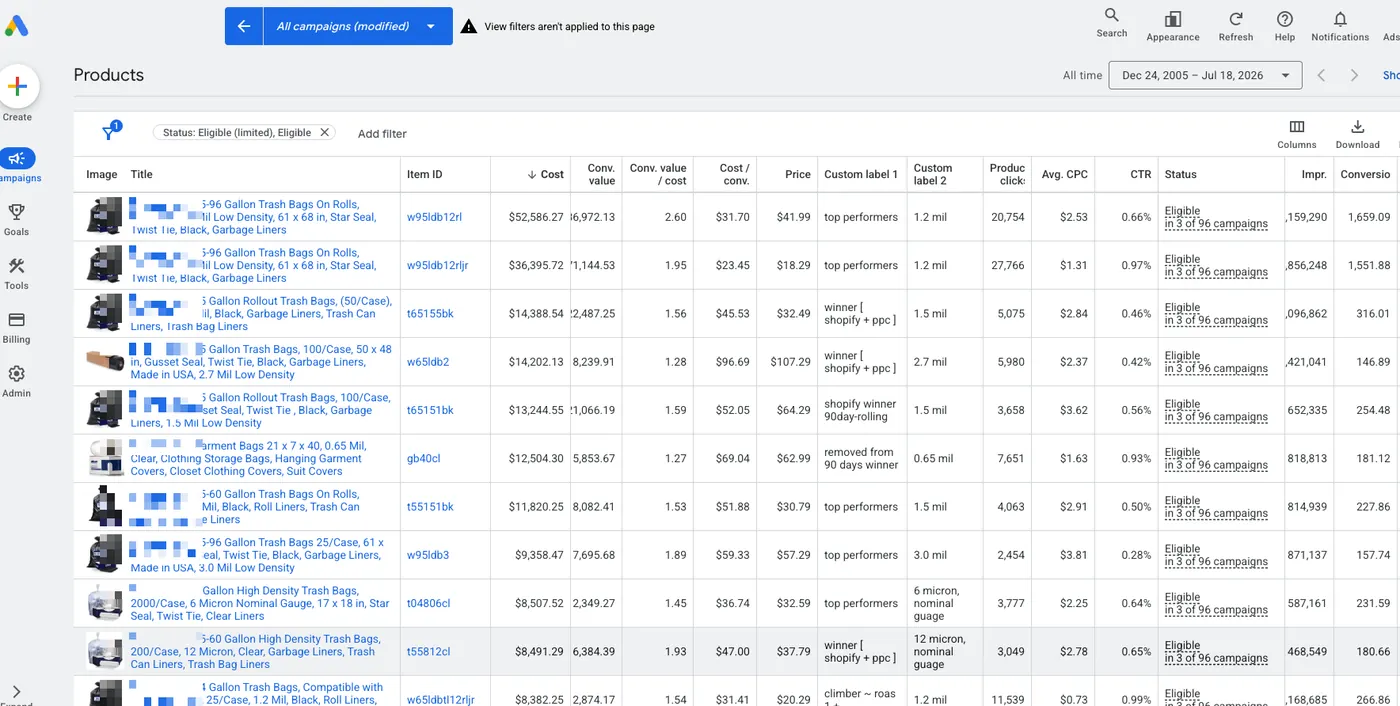
Every SKU gets classified as Hero, Sidekick, or Ghost by contribution after ad spend, using the store's real margins, not revenue. Break-even ROAS is calculated per category with the BE-ROAS Budget Map, so a 65 percent margin product and a 20 percent margin product stop sharing one target. The SKU Spend Alignment Audit then shows where current spend disagrees with that map, which is where the first budget moves come from.
High-AOV categories get isolated. On the vehicle graphics account, truck and SUV wraps and boat side wraps carried the profit, so the work centered on their ROAS trends, SKU ownership, asset group structure, and feed segmentation, and on keeping broader campaigns from bleeding into them. For a US firewood accessories retailer, we segmented the catalog into performance buckets, from consistent earners down to products with spend and no sales, and built a scaling framework on ROAS plus COGS plus contribution margin over about 45 days of data, because ROAS alone flatters low-margin winners.
Custom labels carry the tiers into Merchant Center, so campaigns, budgets, and reports all speak the same product language.
Named tools, not vibes
The same instruments run on every account, so you can ask for any of them by name and get the artifact.
Hero, Sidekick, Ghost
Product classification by contribution after ad spend. Decides isolation, budget, and exclusions.
BE-ROAS Budget Map
Break-even ROAS per category from your margins. Every target on the account traces back to it.
SKU Spend Alignment Audit
The gap report between where spend goes and where margin lives. Rerun monthly; the deltas are the to-do list.
Conversion-Backed Keyword Mapping
Converting search terms feed title and attribute changes, so the feed learns from paid data.
They are the same tools running on our Google Ads and ecommerce accounts, applied to the Shopping channel.
How the first 90 days run
Weeks 1 to 2: audit and feed repair
Read access, Merchant Center diagnostics cleared or in progress, title and attribute fixes shipped through feed rules, tracking verified in GA4 with Enhanced Conversions. No structural rebuilds yet.
Weeks 3 to 6: structure
Products classified into tiers, high-AOV lines isolated, Standard Shopping and PMax roles assigned, exclusions set, budgets moved to the BE-ROAS map. Expect turbulence here; learning resets are real and we schedule around them.
Weeks 7 to 12: calibration
Bid and budget moves on 2-week cycles, query and placement pruning, first scaling decisions on Hero products.
Honest expectations: feed fixes show in eligibility and impressions within days. Profit-level change needs conversion volume, and on most accounts the structure proves itself in the second and third month, not the second week. Anyone promising faster is reading a smaller dataset than they admit.
Pricing, published
Free audit
$0
Founder-recorded Loom: diagnostics, campaign roles, top 3 fixes
Just Free AuditDeep audit
$497one time
Full feed and account teardown with a fix plan. Credited toward month one if you continue
Start the auditMost picked Core management
$997/ month - $5k to $15k/mo ad spend
Feed and Merchant Center upkeep, campaign management, monthly SKU Spend Alignment report
Just Free AuditGrowth management
$1,997/ month - $15k to $25k/mo ad spend
Core plus biweekly optimization cycles, seasonal planning, landing page and CRO input
Just Free Audit
Month to month. 30-day exit. Spending over $25,000 a month? See the full 2026 rate card.
Shopping work you can ask about
Mossy Oak Graphics (US, vehicle wraps)
Full-depth Google Ads account work: Standard Shopping strategy, SKU-level performance review, product exclusions, and isolation of high-AOV wrap categories into dedicated structure. Evaluated Google's own automation prompts before adopting them.
NorthlineExpress (US, firewood accessories)
Product-level Shopping segmentation into six performance buckets and an executive scaling framework built on ROAS, COGS, and contribution margin over roughly 45 days of data.
US personalized gifting brand
Diagnostic case. A 125-day export ending February 26, 2026 showed Shopping returning about $0.17 per dollar and 1,358 products ineligible in the report reviewed. Work in progress: feed eligibility, product segmentation, and role separation before scale. Cited as diagnosis, not as a result.
Lamore Living (UK, luxury beds)
Merchant feed optimization alongside ads and CRO: category attributes, product titles, and feed quality for bed frames, bases, and mattresses.
The full write-ups live where you can see our case studies.
JLM against the usual options
| JustLeadMarket | Large PPC agency | Freelancer or in-house | |
|---|---|---|---|
| Who touches the account | The founder | Account team, rotating | One person, varies |
| Feed work | Included in management | Often separate retainer | Usually skipped |
| Budget logic | Per product, from margin | Blended account ROAS | Platform defaults |
| Standard Shopping | Used where control pays | Often PMax-only | Rarely structured |
| Reporting unit | SKU and category | Campaign totals | Screenshots |
| Contract | Month to month | 6 to 12 months typical | Varies |
| Pricing | On this page | On a call | On a call |
Why stores pick us for Shopping
Feed work included
Merchant Center is inside scope, not an invoice line.
Margin-based budgets
Targets come from your margins, not a blended guess.
Founder runs accounts
The person on the audit is the person in the account.
Standard Shopping kept
We still use the campaign type that shows its data.
SKU-level reporting
You see products, not campaign averages.
US and UK native
One team, both markets, no handoffs.
Month to month
The work retains you, not the paperwork.
Published pricing
The numbers are on this page.
The landing page work in the Growth tier runs through our conversion rate optimization service, and you can read client reviews from the stores above. If your feed is dark right now, we document the Merchant Center suspension appeal process in full.
Facts block
| Service | Google Shopping ads management |
|---|---|
| Ideal for | Shopify and DTC ecommerce stores, 50+ SKUs, $3k to $50k/mo ad spend |
| Markets | United States, United Kingdom |
| Platforms | Google Ads, Google Merchant Center, GA4, Shopify, BigCommerce |
| Campaign types | Standard Shopping, Performance Max, with separated roles |
| What we improve | Feed eligibility, product-level ROAS, budget-to-margin alignment |
| Typical first wins | Disapproval fixes, title coverage, PMax and Shopping overlap removal |
| Pricing | Free audit; $497 deep audit; $997 or $1,997 per month, month to month |
| Proof available | Case cards above; screenshots on request |
| Last updated | 2026-07-17 |
Frequently asked questions
Didn’t find what you’re looking for?
Get the free Shopping audit
What happens next:
You send the store URL and grant read access. 10 minutes.
Abdul records a Loom on your feed, structure, and product-level spend. Within 24 business hours.
You get 3 ranked fixes. Run them yourself or have us do it. Either is fine.
No call, no contract, no follow-up sequence you did not ask for.
Just Free AuditFounder-recorded. Month to month if you continue. 30-day exit.
Why Brands trust Just Lead Market
Just measurable results. No Fluff
