

Scroll
Just Results, Just Reviews
Rated on
REVIEWS

100% success rate
 Verified profile


The Just Free Audit, tuned for pet brands
- A Merchant Center and feed pass on your pet SKUs: titles, GTINs, product types, unit pricing, and disapproval risks
- A search term waste scan with a starter negative keyword map
- Your subscription vs one-time revenue split, and what it changes about your bidding targets
- A tracking check: purchase, subscription, and reorder events in GA4 and Google Ads
- A break-even ROAS target per SKU role, built from your margins
Just Lead Market is a pet marketing agency for DTC ecommerce brands in the US and UK. We manage Google Ads across Search, Shopping, and Performance Max, plus Google Merchant Center and product feeds, conversion tracking, and CRO for brands selling dog food, cat food, cat litter, pet supplements, pet pharmacy items, and pet supplies. Pet retail runs on repeat purchase, so we set bidding targets from contribution margin and reorder behavior instead of a flat ROAS number. Founder-led since 2017. Month-to-month terms. You keep full ownership of every account and asset.
Who this is for
Dog and cat food brands
Kibble, freeze-dried, or fresh subscription. You compete with Chewy and Amazon on price and need DTC margin protected, not spent chasing volume.
Litter brands
Heavy consumable, thin first-order margin once shipping is paid. The account is won or lost on reorder rate, and the bidding has to know that.
Pet supplement brands
Claims are policy-sensitive, feeds get disapproved, and the margin is worth defending. You need ads that stay approved.
Certified pet pharmacies
A restricted category with real rules. You hold LegitScript accreditation and need campaigns built inside Google's policy, not around it.
Supplies and accessories stores
Broad catalogs where a handful of SKUs earn the spend and the rest quietly drain it.
Pet ecommerce runs on the reorder
US pet spending reached $158 billion in 2025, and food and treats is the largest slice at $68.3 billion, per the American Pet Products Association. Most of that basket is consumable. The bag runs out, the box empties, and the buyer purchases again on a cycle you can measure in weeks.
The retailer that proves the point is Chewy: Autoship customer sales were 83.3% of its fiscal 2025 net sales. More than 8 of every 10 dollars came from replenishment buyers, not new ones.
That math sets the strategy for every DTC pet brand. Amazon, Chewy, and chain retail will usually beat you on price and shipping speed. Trying to outbid them for one-time buyers burns margin. The durable play is different: acquire the buyer near break-even on the first order, then earn the profit on the reorder curve you own.
Which is why raw ROAS chasing fails in this category. A 4.0x ROAS on a one-time toy buyer can be worth less than a 1.5x on a fresh-food subscription start, because the subscription pays you back for a year. If your Google Ads management reports ROAS without margin and reorder context, it is optimizing the wrong number.
So we run pet accounts to contribution margin and payback, per SKU, per category. The next section shows the categories and the planning math.
Pet categories we run
This page is the hub for every pet ecommerce category we work in. Dedicated guides for dog food, cat food, litter, and supplements are planned as their own pages; until they publish, this is the home for each.
The table below shows the directional planning ranges we use to set a starting break-even ROAS before your account data replaces them, usually within the first two weeks. Figures are compiled from public category research, marked with ~, and are not client results.
| Category | Typical AOV | Gross margin | Customer LTV | Reorder rate | Typical CPC |
|---|---|---|---|---|---|
| Dog food, kibble | $80~ | 35%~ | $900~ | 70%~ | $3.20~ |
| Dog food, fresh subscription | $120~ | 40%~ | $1,200~ | 65%~ | $3.80~ |
| Cat food, kibble | $55~ | 35%~ | $700~ | 70%~ | $2.90~ |
| Cat food, fresh subscription | $95~ | 40%~ | $1,000~ | 60%~ | $3.50~ |
| Cat litter, clumping clay | $40~ | 25%~ | $300~ | 75%~ | $2.20~ |
| Cat litter, natural and silica | $55~ | 30%~ | $400~ | 75%~ | $2.40~ |
| Pet supplements | $58~ | 76%~ | $320~ | 55%~ | $3.80~ |
| Pet pharmacy | $160~ | 30%~ | $580~ | 75%~ | $4.80~ |
| Supplies and accessories | $90~ | 45%~ | $270~ | 50%~ | $3.50~ |
| Dog toys and enrichment | $32~ | 60%~ | $85~ | 35%~ | $2.10~ |
Dog food and cat food
Food is the deepest category we plan for, and the one where subscription changes everything. A fresh-food subscription start at $120~ AOV justifies a first-order target below break-even, because the 12-month value sits near $1,200~ if retention holds. Kibble runs the same logic at lower price points with 70%~ reorder rates.
The feed work is specific here. Titles front-load brand, species, life stage, and bag size inside the first 70 characters. Unit pricing (price per pound) goes into the feed so Shopping can show value against the big-box listing next to you. Product types follow a species, life stage, and diet taxonomy so campaigns can split by role. Flavor and size variants get grouped so they assist the hero SKU instead of competing with it.
On price pressure: we do not try to win the generic "dog food" auction against Chewy. We split brand from non-brand, defend the brand term cheaply, and put non-brand budget only where your margin survives the click.
Cat litter
Litter is a shipping-weight problem wearing a marketing costume. At $40~ AOV and 25%~ margin on clay, one careless free-shipping promise erases the order profit. Natural and silica formats carry better margin at $55~ AOV and hold the same 75%~ reorder rate, which is the highest in the category table. We set bids from margin after shipping, push subscribe-and-save on the product page, and make box count and weight explicit in feed titles so the click that arrives already knows the deal.
Pet supplements
Our deepest regulated-category work is in human supplements, and the compliance and feed mechanics transfer directly: label-aligned claims, policy-safe product copy, consistent data between feed and landing page, and standard disclaimers where required. Pet supplements run the same discipline with a different species on the label.
The economics are the draw. At 76%~ gross margin, supplements can afford acquisition costs that food cannot, which makes them a common second category for food brands. The constraint is claims risk: one disease-treatment phrase in a title or product page can pull a disapproval that stalls the whole feed. We write and structure product data so that does not happen, and we keep a Do and Avoid claims sheet in the account so future SKUs launch clean.
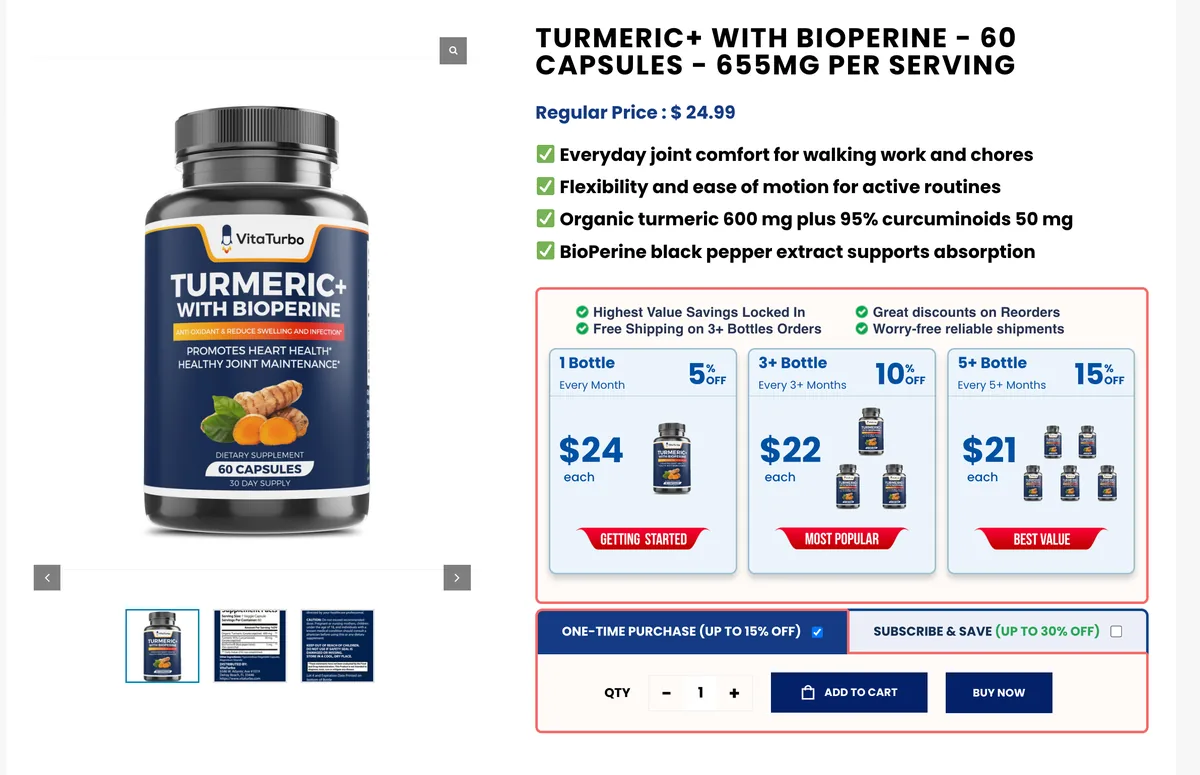
A live product page from VitaTurbo, the US supplement DTC store on our roster: "supports" claim phrasing and subscribe-and-save reorder tiers. Pet pharmacy and medications
A restricted category with rules we plan around, not against. Google allows Shopping ads for pet pharmacies in the US and Canada only, and merchants must hold LegitScript healthcare certification. Keyword-targeting animal prescription drug terms also requires certification. Prescription items dispense against a valid vet prescription, and your site flow has to show it.
If you are accredited, we build the compliant campaign structure: certified account setup, OTC and Rx separation, and feed data that matches your dispensing pages. If you are not accredited yet, accreditation comes first, and we will tell you that before taking a dollar of ad spend.
Supplies, chews, and wellness accessories
Broad catalogs live or die on pruning. A 500-SKU store usually has 20 products that earn the spend and 200 that leak it. We classify the catalog by contribution, restructure Shopping around the earners, and let Q4 gifting demand carry the accessories that cannot pay for clicks in March.
Toys, enrichment, and content-led pet shops
The honest read: at $32~ AOV and 35%~ reorder, standalone toy stores rarely pay for paid search on single-item orders. Toys work in paid when they ride along a consumables catalog or bundle into a higher AOV. If that is your store, we would start with bundle economics and CRO before scaling ad spend, and we will say that in the audit rather than take the budget.
The human-supplement side of that work, from claim-risk rewrites to subscription bidding, lives on our health and wellness marketing agency page.
What we run, and what we do not
Scope for pet accounts:
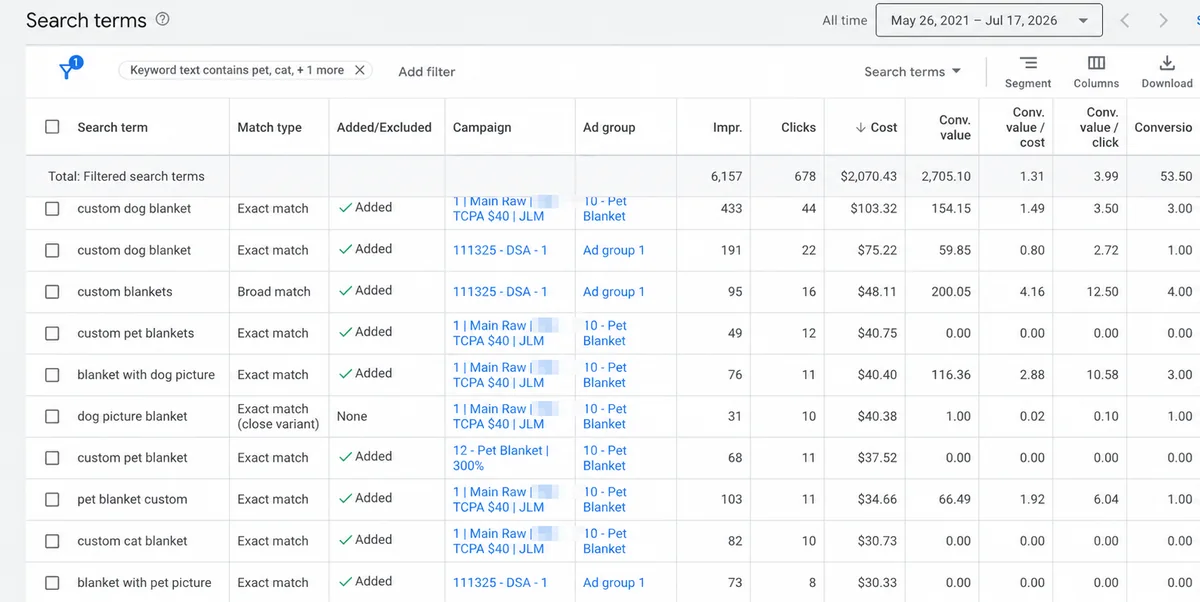
Paid search
Brand and non-brand split, match-type discipline, and query review on a weekly cadence.
Shopping and Performance Max
Standard Shopping and PMax tested against each other with clean inputs, segmented by SKU role rather than dumped in one campaign.
Merchant Center and product feeds
Title structure, GTINs, product types, unit pricing, availability accuracy, and disapproval prevention. Our free Merchant Center product title tool shows the exact title logic we apply.
Conversion tracking
GA4, Google Ads conversions with hashed-email Enhanced Conversions, and subscription and reorder events, so repeat revenue is visible to bidding.
CRO
Product page and subscription offer testing with our conversion rate optimization process, because a better subscribe-and-save block beats a bid change.
Out of scope, stated plainly: we do not run pet influencer, organic social, or PR campaigns. Agencies on this page's search results do that well. If creator content is your main lever, we are the wrong pick and will point you elsewhere.
How we decide where the money goes
Three named tools we already use across ecommerce accounts, applied to pet economics.
BE-ROAS Budget Map
Every SKU gets a break-even ROAS computed from contribution margin after shipping. A 40 lb litter box and a 2 oz supplement jar cannot share a target. Subscription starters get a first-order target below break-even, capped by a 90-day margin payback rule, so acquisition spends ahead only where the reorder curve repays it.
Hero, Sidekick, Ghost
Catalog roles by contribution. Heroes are the subscription starters and best-selling count sizes that get budget and their own campaigns. Sidekicks are the flavors and size variants that assist, grouped so they support the hero instead of splitting its data. Ghosts are the heavy, low-margin singles that quietly eat Shopping spend; they get excluded or demoted until they earn a role.
Cautious negative keyword work
Pet queries are full of traps: free, DIY, recall news, homemade recipes, vet questions. We add negatives in weekly review cycles with conversion evidence behind each cut, instead of bulk lists that choke Smart Bidding's learning. Converting queries also feed the keyword map for later SEO pages, the same conversion-backed mapping we use on our ecommerce SEO work.
The process, with honest timeframes
Weeks 1 to 2: foundation
Audit, tracking fixes, feed corrections. Merchant Center and data quality come before any structural change, in that order, every time.
Weeks 3 to 4: structure
Brand and non-brand split, Shopping rebuilt around SKU roles, PMax fed clean signals, negative keyword baseline installed.
Months 2 to 3: scale and read
Budget moves toward proven margin. Standard Shopping and PMax get compared on real numbers. Query review runs weekly.
Ongoing: reorder readout
Consumables give a clean read after one full reorder cycle, usually 60 to 90 days for food and litter. We report cohort payback, not just last-click ROAS.
No lock-in at any stage. Month-to-month, 30-day exit, and the account stays yours if you leave.
What we bring to a pet account
No invented pet case studies here. What you get is the mechanics below, already run on real accounts, applied to pet economics from day one.
Regulated-category foundation, US supplement DTC store
Compliance-first growth work: feed accuracy, policy-safe product copy, tracking plan, and a working order of Merchant Center first, then product pages, then tracking, then campaign structure, then scale. The same order every pet supplement and pharmacy account needs.
Merchant feed and category data, UK home retailer
Feed optimization and category-level product data across a large catalog. The work raised keyword relevance in the feed and cleaned the data Shopping campaigns bid on.
Account cleanup and intent mapping, US personalized gifting brand
A 125-day export analyzed line by line: search intent separated, roles split across Search, Shopping, and PMax, waste cut with evidence, learning protected.
More on the case studies page, and client words on the reviews page.
How we compare
| Generalist PPC agency | Pet creative and influencer agency | Just Lead Market | |
|---|---|---|---|
| Success metric reported | ROAS | Reach and engagement | Contribution margin and payback |
| Feed and Merchant Center | Basic sync | Rarely touched | Rebuilt before spend scales |
| Subscription economics in bidding | Flat ROAS target | Not applicable | First-order targets from reorder math |
| Negative keyword cadence | Quarterly or on request | Not applicable | Weekly, evidence-backed |
| Contract | 3 to 12 month terms common | Varies | Month-to-month, 30-day exit |
No agency type above is wrong. They optimize different levers. Ours is margin.
Why pet brands pick us
Margin first, not ROAS
Bids come from contribution margin after shipping, per SKU, so growth is profit you keep.
Feed fixed before spend
Merchant Center accuracy is step one, because scaled spend on a broken feed just scales the waste.
Reorder math in bids
Subscription and repeat purchase behavior sets first-order targets. One-time and reorder buyers are not the same customer.
Policy work built in
Supplements and pharmacy run inside Google's rules from setup, not after the first disapproval.
Founder runs the account
Abdul has run Google Ads for ecommerce brands since 2017. No handoff to a junior pod.

No junior pod. There is a supervisor, though. Month-to-month terms
30-day exit. The work has to earn the renewal.
You own every asset
Accounts, data, feeds, and creative stay in your name from day one.
Facts block
| Service | Pet ecommerce marketing: Google Ads, Shopping and Performance Max, Merchant Center and feeds, CRO, conversion tracking |
|---|---|
| Ideal for | DTC pet brands: dog and cat food, cat litter, pet supplements, certified pet pharmacies, pet supplies |
| Markets | US, UK |
| Platforms | Google Ads, Google Merchant Center, GA4, Shopify, WooCommerce, BigCommerce |
| Typical AOV range | $32~ to $160~ by category; see the planning table above |
| Seasonality | Consumables steady year round; toys, apparel, and gifting accessories peak in Q4 |
| What we improve | Contribution margin per order, CPA on subscription starts, feed approval rate, tracking accuracy |
| Typical first wins | Tracking cleanup, feed and title fixes, query waste removal |
| Proof available | Adjacent-category work summaries on request |
| Last updated | 2026-07-17 |
Sources and methods
US pet industry spend and category size: American Pet Products Association, 2026 State of the Industry Report (americanpetproducts.org). Autoship share of net sales: Chewy fiscal 2025 results (investor.chewy.com). Pet pharmacy advertising rules: Google Merchant Center Healthcare and medicines policy (support.google.com/merchants/answer/6150151). The category planning table contains directional ranges compiled from public category research, marked with ~; they are planning inputs, not client results and not a promise of outcomes.
Frequently asked questions
Didn’t find what you’re looking for?
Start with a Just Free Audit
What happens next:
Send your store URL and margin basics through the form. Two minutes.
We review your feed, search terms, tracking, and margin targets with read-only access.
The report lands in your inbox in 2 to 5 business days with a 30-day plan you can run with or without us.
No contract, no pitch deck, no obligation to hire us after.
Just Free AuditMonth-to-month. 30-day exit. 100% account ownership.
Why Brands trust Just Lead Market
Just measurable results. No Fluff
