




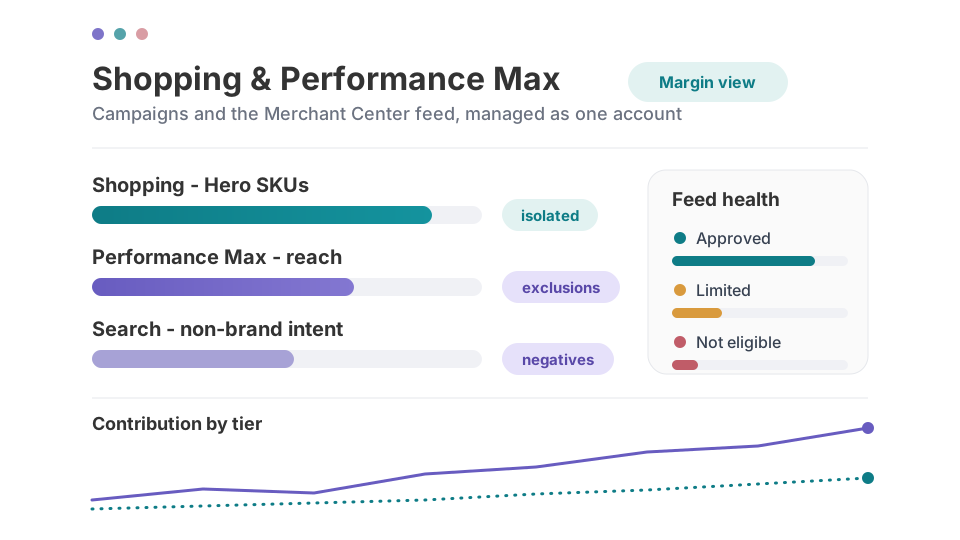
Campaigns and the Merchant Center feed, managed as one account.
The account structure we run for stable growth. Watch on YouTube
Three feed fixes that move Shopping and PMax ROAS. Watch on YouTube
Why your ads go missing from the Map Pack. Watch on YouTube
Scroll
Just Results, Just Reviews
Rated on
REVIEWS

100% success rate
 Verified profile


The free ecommerce PPC audit
- A search term waste map: which queries spend without converting, and the negative keyword list to stop them
- A Merchant Center diagnostic: disapprovals, title quality, and feed gaps that are keeping products out of auctions
- A Performance Max structure read: whether PMax is acting like Shopping, like Search, or like a black box
- A tracking check: GA4 events and Enhanced Conversions, so decisions run on real data
- A Loom video walking through all of it, recorded by the founder
JustLeadMarket is an ecommerce PPC agency for Shopify and DTC stores in the US and UK. We manage Google Shopping, Performance Max, and Search, and we work inside Google Merchant Center on the product feed itself: titles, product types, custom labels, and disapprovals. Budgets follow contribution margin per category, not one blended ROAS target. The service is founder-led and month to month, and it starts with a free audit delivered as a Loom video within 24 hours. The outcome we manage toward is simple: more profit from the same ad spend, measured in your own account data, not in a slide deck.
Who this is for
Shopify and DTC stores spending $3k to $50k a month on Google Ads
You see revenue in the dashboard but cannot see profit by product. We rebuild the account so budget follows margin.
Stores where PMax "does everything"
Nobody can say which products or queries drive it. We add product exclusions and structure so you can.
Brands whose feed was set up once at launch
Disapprovals sit for months, titles never change, custom labels do not exist. Feed work is inside our scope, not an extra.
US and UK stores tired of vendor ping-pong
One team on ads, feed, and tracking instead of three vendors pointing at each other.
What our ecommerce PPC management covers
Six workstreams. Every account gets all six, weighted to where the audit finds the leaks.
Google Shopping
Campaign structure by margin tier, not by whatever the platform imported. Query sculpting between Shopping and Search so branded, generic, and product-specific traffic land where they convert cheapest. SKU-level bid logic instead of one campaign-wide target.
Performance Max control
Asset groups built around product roles. Product exclusions so Standard Shopping keeps clean data. Regular checks on whether PMax is behaving like a Shopping engine or quietly turning into an expensive Search campaign. Brand traffic separated so PMax cannot take credit for customers who already knew your name.
Product feed and Merchant Center
Titles rewritten to match how buyers actually search. Product types and custom labels that let campaigns target margin tiers. Disapproval and misrepresentation fixes before they become account-level problems. This is the workstream most PPC agencies hand back to the client. We consider it half the account.
Search campaigns
Non-brand intent segmentation, so research traffic and buying traffic stop sharing a budget. Negative keyword frameworks that remove waste without blocking the category terms your store depends on. Ad copy written against the landing page it points to, because Quality Score is a relevance grade, not a mystery.
Tracking and measurement
GA4 events checked, Enhanced Conversions with hashed email set up, Merchant Center diagnostics cleared. This happens before scaling, not after, because every budget decision downstream depends on it.
Budget and bid governance
Portfolio target ROAS where it earns its place, CPC caps where automation overreaches, shared budgets reviewed instead of set and forgotten. Spend moves toward the categories your margin data ranks first.
The feed is half the account
Google Shopping has no keywords. Google reads your product titles, descriptions, and attributes, then decides which auctions you enter. If the words buyers search are not in your title, you never bid, no matter how high your budget goes.
That makes the feed the single most valuable file in your ad account, and it is the one most agencies never open. Typical split: the PPC agency says the feed belongs to the developer, the developer says it belongs to marketing, and disapprovals sit in Merchant Center for a quarter.
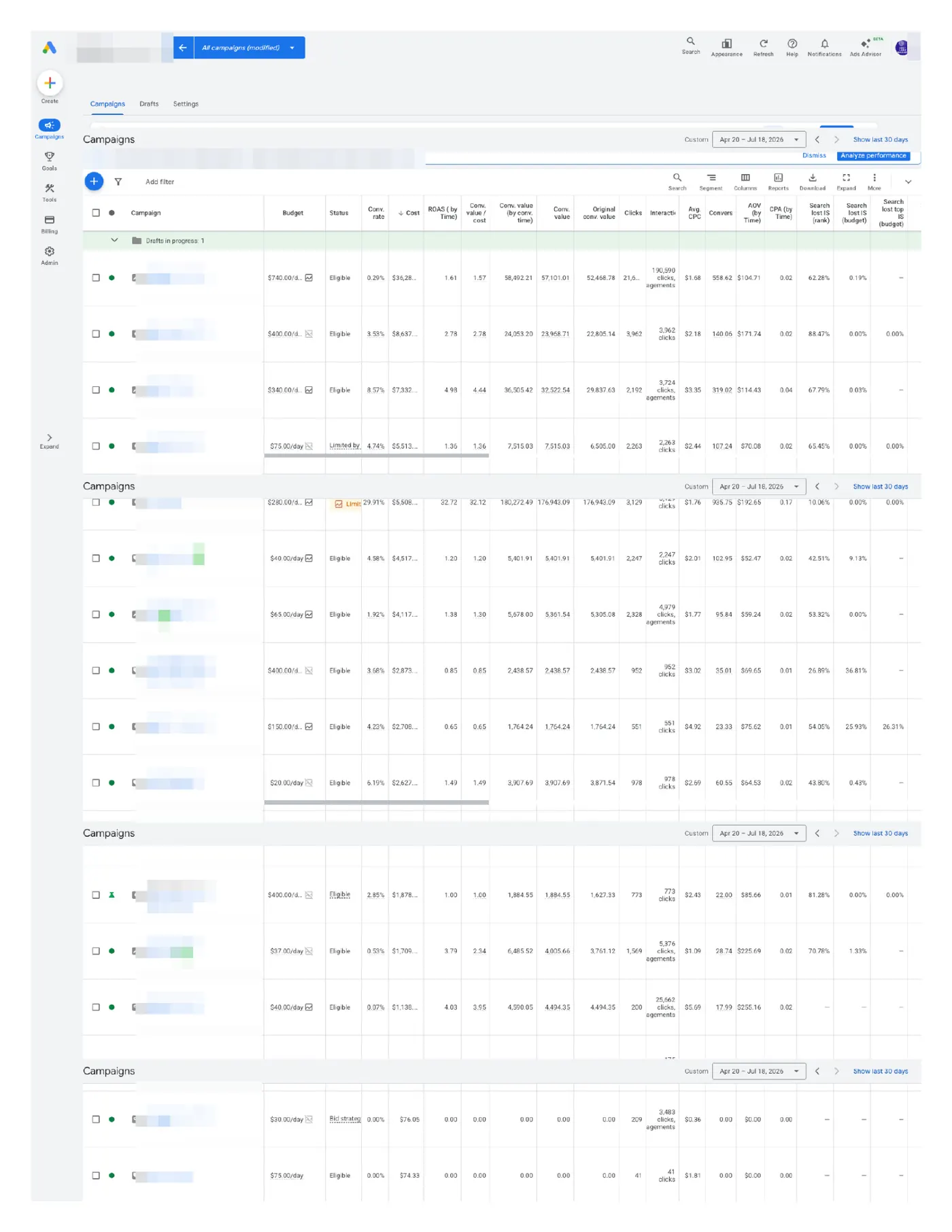
We work inside Merchant Center as part of standard management. On one US account we reviewed, the product report showed 1,358 products flagged not eligible in that export, most with no campaign serving them at all. That store was paying for traffic while most of its catalog sat outside the auction. Feed diagnostics found it in an afternoon.
What the feed workstream covers: title rewrites against real query data, product type and Google category corrections, custom labels for margin tiers and seasonality, disapproval triage, and rules that keep the feed clean as the catalog changes. If you want to see the depth we go to on product data, our free CRO checklist for online stores includes the feed and product-page checks we run: Ecommerce CRO checklist.
If the problem is specifically the Shopping channel, our dedicated Google Shopping agency page runs the feed-first version of this work.
How we decide where your budget goes
We do not run accounts on one blended ROAS number. Blended targets hide losers behind winners. Three named tools do the work instead.
Hero, Sidekick, Ghost
Every SKU or category is classified by contribution after ad spend. Heroes earn isolated campaigns and protected budgets. Sidekicks support Heroes in shared structures. Ghosts, products that spend without contributing, get excluded so they stop taxing the rest.
The BE-ROAS Budget Map
Break-even ROAS is calculated per category from your margins, not guessed account-wide. A 3.0x target is a loss on one category and sandbagging on another. The map sets a floor per category so bidding targets mean something.
The SKU Spend Alignment Audit
A side-by-side of where spend goes versus where margin lives. When 40 percent of budget sits on products producing 10 percent of contribution, that is the reallocation plan, written by your own data.
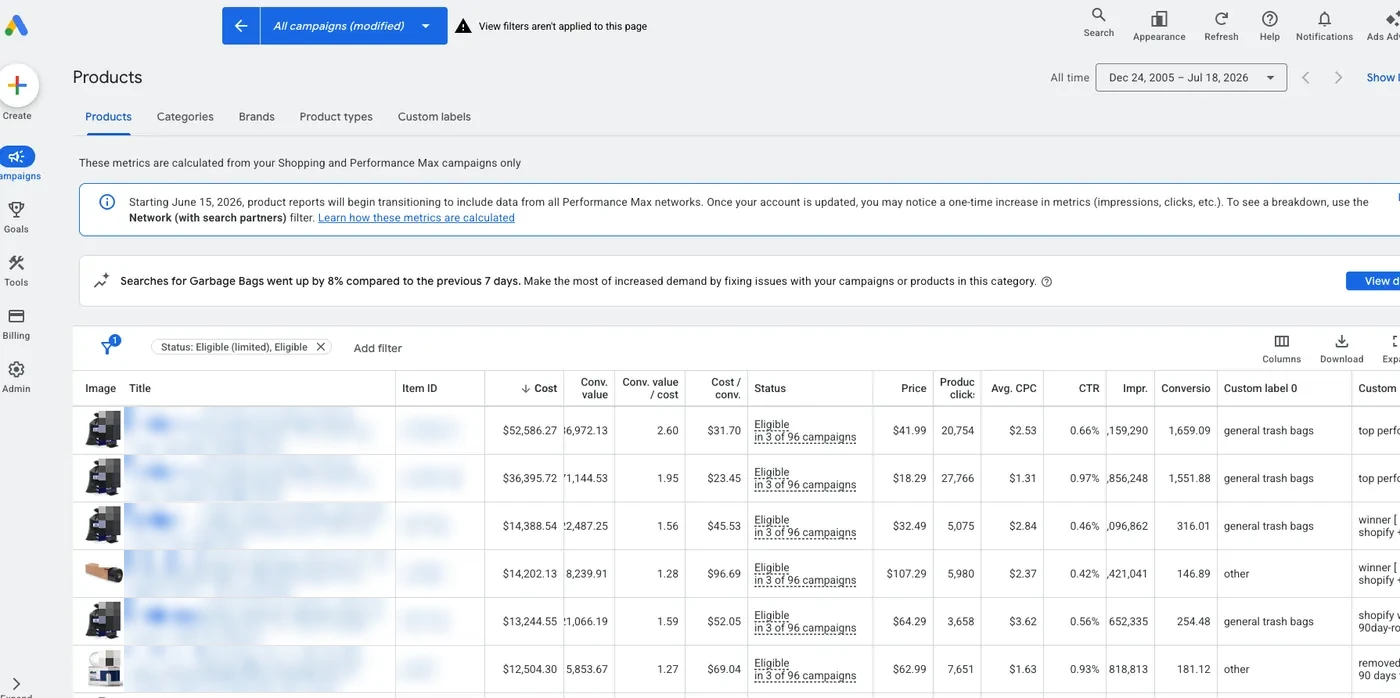
The same discipline applies to product segmentation scripts. On a US hearth-products store we segmented the entire Shopping catalog into performance buckets (Elites, Regulars, Climbers, Strugglers, Ghosts, Sleepers) and built the scaling case on ROAS plus COGS plus contribution margin over a 45-day window, because ROAS alone flatters the wrong products.
Our ecommerce PPC process
Week 1: audit and tracking
Full account and feed audit. GA4 and Enhanced Conversions fixed first. You get the findings as a Loom, in plain language.
Weeks 2 to 4: stop the leaks
Negative keyword framework live. Feed disapprovals cleared, priority titles rewritten. Structural changes ship in sequence, not all at once, so we can read what each change did. Accounts that change ten things in a week learn nothing.
Month 2: reallocate
Budget moves to the categories the BE-ROAS map ranks first. PMax and Standard Shopping split-tested where the data says the split is worth it. High-margin categories isolated where they earn it.
Month 3 and on: scale what holds
Winners get budget. Reporting stays weekly: spend, revenue, contribution by tier, and what changed, on one page.
Honest timeline: expect cleanup wins inside the first 30 days and durable ROAS movement over 60 to 90 days. Anyone promising a week-one transformation is describing a bid change, not a system.
Ecommerce PPC pricing
We list prices so you can qualify us fast. Most agencies make you book a call to hear a number.
Just Free Audit
$0Any store
Send your URL. Loom video within 24 hours covering your three biggest paid search problems and whether PPC is even the right next spend. Sometimes it is not, and we will say that.
Just Free AuditPPC Foundation
$497one time - Any store
The full ecommerce PPC audit: search term waste map, Merchant Center diagnostics, PMax and Shopping structure review, tracking check, and a 90-day roadmap with a Loom walkthrough. Credited toward your first month.
Start the auditMost picked PPC Core
$997/ month - $5k to $15k/mo ad spend
Shopping, Search, and PMax managed. Feed maintenance and disapproval triage included. Negative keyword program. Weekly one-page scorecard.
Just Free AuditPPC Growth
$1,997/ month - $15k to $25k/mo ad spend
Everything in Core plus margin-tier budget maps, Demand Gen and YouTube remarketing, landing page test coordination, and quarterly strategy reviews.
Just Free Audit
No long contracts. Month to month with a 30-day exit. Most clients start with a 90-day pilot. Spending over $25,000 a month? See the full 2026 rate card.
Results from real accounts
Mossy Oak Graphics (US, vehicle wraps and graphics)
Full-depth Google Ads management: Search, Performance Max, Shopping, portfolio target ROAS, and shared budget governance. High-AOV categories (Truck/SUV wraps, Boat Side wraps) isolated into dedicated asset groups with their own feed segmentation. Evaluated Google's AI Max recommendation against query-expansion and overlap risk instead of auto-enabling it on a granular account. Budget moved toward Tier 1 and Tier 2 categories.
ThatBlanket (US, personalized photo blankets, DTC gifting)
A growth-system rebuild in progress. In a 125-day export ending February 26, 2026, the diagnosis showed why blended numbers mislead: photo, picture, and collage queries ran near 1.20x ROAS while kids and baby themes ran near 0.15x and sports themes converted at 0x in the same account. Brand terms returned about 5.61x on roughly $537 of spend. The rebuild separates campaign roles across Search, PMax, Shopping, and Demand Gen, applies a cautious negative framework that removes waste without blocking core photo-blanket intent, and plans product segmentation by gift angle and margin. Data points are from that specific export window, not ongoing performance.
NorthlineExpress (US, hearth and firewood accessories)
SKU-level Shopping analysis using the Leap Labelizer V1.3 script, segmenting the catalog into Elites, Regulars, Climbers, Strugglers, Ghosts, and Sleepers. Built a CEO-facing scaling framework on roughly 45 days of data, ranking categories by ROAS plus COGS plus contribution margin rather than ROAS alone. Also wrote Quality Score-friendly ad copy across the firewood accessories range.
Two more US accounts, a packaging store and a supplement brand, shaped our search-to-landing-page relevance playbook and our compliance-safe approach for regulated categories. More on the case studies page.
Supplement and wellness stores get the compliance-first version of this playbook on our health and wellness marketing agency page.
Comparing us against other shops? Our guide to how to choose an ecommerce PPC agency lists the five first-call questions, the ownership terms to get in writing, and the red flags that only show up inside the account.
How we compare
| JustLeadMarket | Typical PPC agency | Freelancer or in-house | |
|---|---|---|---|
| Feed and Merchant Center work | Included in management | Usually "the client's job" | Varies, often nobody's job |
| Budget logic | Break-even ROAS per category from your margins | One blended ROAS target | Platform recommendations |
| PMax handling | Product exclusions, asset group structure, brand separated | Set and monitor | Default settings |
| Reporting | Weekly one-page scorecard | Monthly deck | Ad hoc |
| Who touches the account | The founder | An account manager relaying to a team | One person, single point of failure |
| Contract | Month to month, 30-day exit | 6 to 12 month terms | N/A |
| Pricing | Listed on this page | Book a call to hear a number | Varies |
Why brands pick us for ecommerce PPC
Feed work included
Merchant Center is inside scope, not an upsell or a handback.
Margin over blended ROAS
Targets set per category from your margins, so winners stop subsidizing losers.
PMax under control
Exclusions and structure make the black box readable.
Founder runs the account
The person you talk to is the person in the account.
Prices listed, no call
Brackets are on this page. Qualify us in two minutes.
Month to month
30-day exit. The work has to earn the renewal.
Tracking fixed first
No scaling decisions on data we do not trust.
One team, US and UK
Both markets managed natively, one point of contact.
Facts block
| Service | Ecommerce PPC management |
|---|---|
| Ideal for | Shopify and DTC stores spending $3k to $50k a month on Google Ads |
| Markets | US, UK |
| Platforms | Google Ads, Google Shopping, Performance Max, Google Merchant Center, GA4 |
| What we improve | ROAS, CPA, wasted spend share, feed approval rate, tracking accuracy |
| Typical first wins | Tracking cleanup, feed disapproval fixes, search term waste reduction |
| Pricing | Audit $0, Foundation $497 one time, management from $997/mo |
| Proof available | Case cards on this page, client reviews |
| Last updated | 2026-07-16 |
Ecommerce PPC FAQs
Didn’t find what you’re looking for?
Find out where your ad account leaks before you spend another month funding it.
What happens next:
Send your store URL. Read-only access optional but sharper.
Within 24 business hours you get a Loom: your three biggest paid search problems and what fixing them is worth.
You decide. Keep the findings either way.
5 minutes from you. 24 business hours from us.
The audit is the pitch. There is no follow-up sequence and no pressure call.
Just Free AuditFounder-recorded Loom. Read-only access. Real client reviews
Why Brands trust Just Lead Market
Just measurable results. No Fluff
