
AI can run the reading layer of a Google Ads account: pulling performance data on a set cadence, checking feeds and pacing, flagging anomalies, and drafting changes with reasons attached. It should not push changes live. Bids, budgets, and brand defense stay behind human approval. That split holds even on accounts spending $50,000 a month.
This page describes a system we run in production on ecommerce Google Ads accounts, not a prediction about what AI might do someday. It covers what the AI reads, which checks it runs, where the human approval line sits, and the one incident that hardened the rule about brand campaigns.
The split that works on a real account
It is a page the search results currently do not contain. In Ahrefs SERP data pulled August 2026, the top organic result for "ai ppc management" in the US is a Reddit thread asking whether anyone actually uses AI-native campaign tools, and three of the nine organic results are Amazon PPC software pages. Plenty of promises about controlling spend with AI. No workflow, no governance model, no first-hand account of a working Google Ads setup. So here is ours.
Start with a fact that reframes the question. More than 80% of Google advertisers use automated bidding: internal Google data collected in March and April 2021, published by Google in May 2022 and still carried on its Ads Help page today. Machine bidding is not the frontier; it is the default, and it already runs inside your account. AI in PPC management today is about the agent layer above the auction: the reading, checking, and drafting work, and the governance of what that agent may touch.
Here is the division of labor we use:
| Account task | Who runs it | Why |
|---|---|---|
| Daily spend and pacing reads | AI | Arithmetic across every campaign needs consistency, not judgment |
| Search term and placement audits | AI drafts, human approves | High-volume reading; exclusions still change delivery, so they ship on approval |
| Feed and disapproval checks | AI flags, human fixes | A status change matters the day it happens, not at the weekly review |
| Anomaly flags (CTR, CVR, CPC swings) | AI | Pattern detection across hundreds of SKUs beats spot checks |
| Ad copy and asset drafts | AI drafts, human edits and ships | Drafting volume is cheap; judgment on claims and brand voice is not |
| Bid target changes | Human | Money moves; models miss context such as rank defense |
| Budget moves | Human | Set against break-even ROAS; a strategy call, not a calculation |
| Brand campaigns | Human only | Efficiency logic reads brand defense wrong; the incident below is why |
| Campaign structure | Human | Architecture decisions compound for months |
| Google's auto-applied recommendations | Neither | A third party changing your account; govern it separately |
What an AI actually runs well
On our accounts, the AI layer does four kinds of work.
It reads. Campaign, ad group, search term, and product-level data through the API, plus Merchant Center status. An account at $30,000 to $50,000 a month generates more reading than any human does consistently. The AI does the same full pass on day 40 that it did on day 1.
It checks on a cadence. The same checks, at the same rhythm, every time: pacing against plan, disapprovals, feed status, spend drift by product. Daily and weekly performance analysis runs sit on top of those, and that is what buys the early read: a trend that would otherwise surface in a monthly review shows up while there is still budget left to redirect. A human team runs versions of these too, but the weekly version of a daily check misses six days.
It drafts with reasons. Proposed negatives, proposed exclusions, proposed feed fixes, each one carrying the data that produced it. A proposal without its evidence cannot be reviewed, only rubber-stamped, so evidence is mandatory.
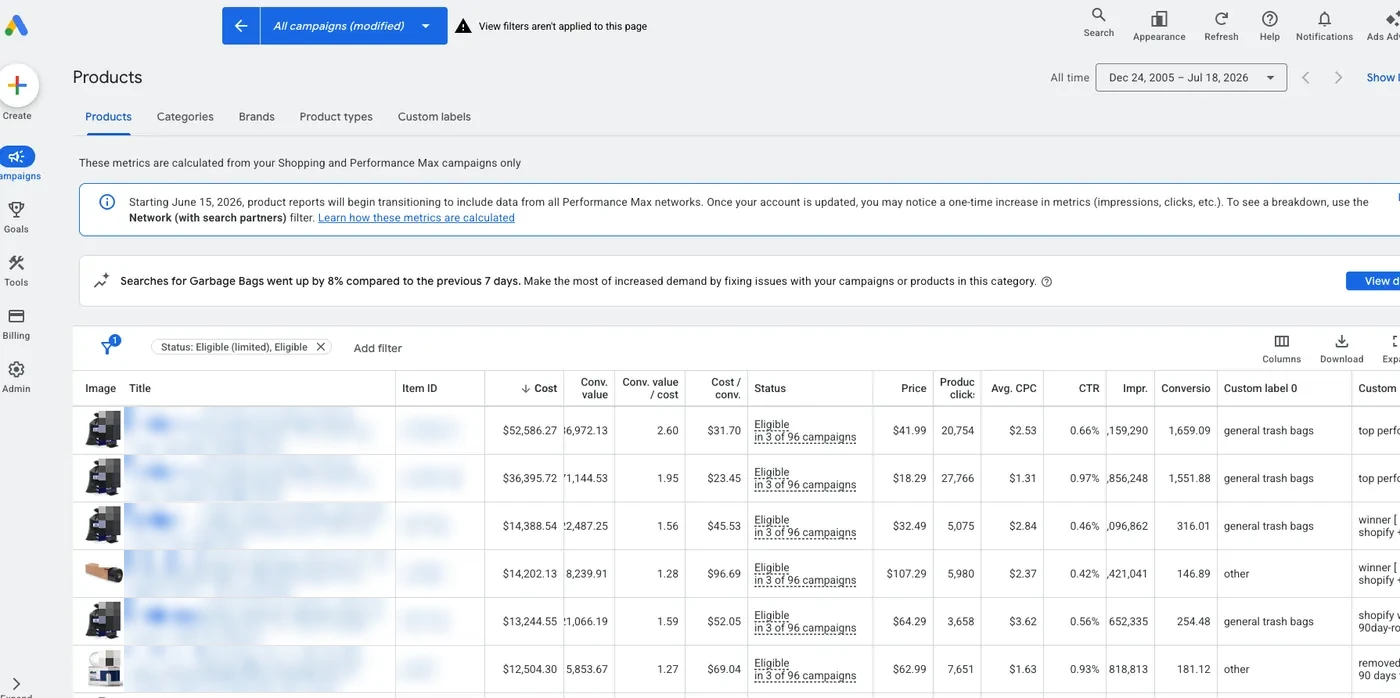
It collects browser evidence. The API does not expose everything. Some Merchant Center diagnostics and policy states only render in the interface, so the AI captures what it sees in the browser and attaches the screenshots to its proposals. The human approving a change looks at the same evidence the AI saw.
That reading and checking layer is where an AI agent for PPC earns its keep, and it is the part most writeups skip in favor of bidding talk. Bidding was automated before the current AI wave arrived.
If I had to name the one job where the agents genuinely outrun a person, it is cross-source analysis. A weekly read that pulls BigQuery exports, Ahrefs data and Google Trends together, and holds all three against what the account actually did, is work a human does slowly, inconsistently, and usually not at all once the week gets busy. The agent does it every week at the same depth. Everything else on this list is the AI being more consistent than a person. This is the AI being better.
What stays human, and why
Three things never sit on the AI side of our line: bid target changes, budget moves, and brand defense.
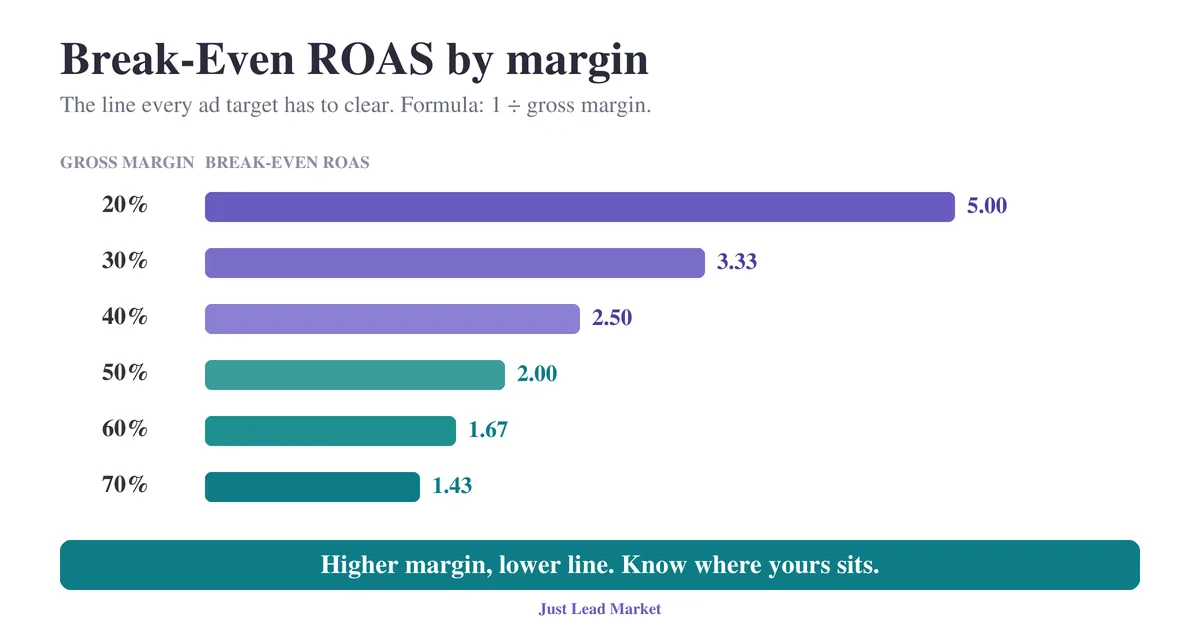
Bid targets and budgets move money. A model can compute its way to a defensible number and still be wrong, because the number is not the whole decision. On our accounts, budget moves run through break-even ROAS first: the return each campaign must clear before another dollar makes sense, which we wrote up in our break-even ROAS guide. That calculation feeds a human decision. It does not replace one.
Campaign structure stays human for a different reason: consolidations and splits shape learning data for months, so a structural mistake is slow to surface and slower to undo.
And brand. Brand gets its own section, because it produced the most instructive mistake our system has made.
The day the AI proposed cutting brand bids
On a live ecommerce account we manage, the AI flagged brand campaigns as a cut. The logic was clean ROAS arithmetic: brand spend looked expensive relative to the incremental return as the model read it. On paper, a defensible proposal. Any pure efficiency model reads brand this way eventually.
It was wrong, and a human overruled it on rank defense. Brand terms are the cheapest clicks in the account and the gate to everything downstream. Cut your brand bids and you do not bank the savings: you hand the top position on your own name to whichever competitor is bidding on it, then buy back demand you already owned at a worse price. The ROAS math had no column for that.
Where AI PPC management goes wrong
Full autopilot. Letting the model push changes live without review is the failure that costs the most. Approval takes a person seconds per change. The first bad unreviewed change on a $50,000 account pays for years of approval clicks.
Confusing Google's auto-apply with AI management. Auto-applied recommendations are Google changing your account by default, tuned to Google's objectives. That is not an agent working for you, and leaving them ungoverned while adding an AI layer is automating on top of noise. Our auto-recommendations firewall covers which ones to allow and which to block.
Efficiency logic applied to brand. Covered above. Any ROAS-only objective will eventually propose cutting the campaigns that defend your name.
API-only vision. An AI that reads only the API misses what the interface shows: certain diagnostics, policy states, and disapproval detail. It will reason confidently from partial evidence. Browser capture closes that gap.
No reasons attached. If proposals arrive without the data that produced them, your approval step is theater. The evidence trail is the governance.
What the wrong split costs
Simple arithmetic, using round numbers; substitute your own. Take one unreviewed bad change that misallocates 10% of spend and runs for a week before anyone notices:
| Monthly spend | Daily spend | 10% wasted for 7 days | Revenue not earned at a 3.0 ROAS target |
|---|---|---|---|
| $10,000 | $333 | $233 | $700 |
| $30,000 | $1,000 | $700 | $2,100 |
| $50,000 | $1,667 | $1,167 | $3,500 |
That is one modest mistake, caught inside a week. A change that runs for a month, or a brand-bid cut that hands a competitor your name for a quarter, costs multiples of it.
The opposite error has a price too. No AI layer usually means daily reading happens weekly, so a feed disapproval on your best seller can sit from Monday to Friday: four days of your top product not serving while everyone assumes the account is fine.
Where the line sits by spend: below roughly $10,000 a month, skip the AI layer and run the checks yourself; they fit in a few focused hours a week. Above that, the reading volume outgrows spot checks. Above $50,000, the question is no longer whether an AI layer helps but who governs it, because at that spend every ungoverned change is a four-figure event.
How we run it at Just Lead Market
Our Google Ads management runs the AI Google Ads management setup described above on ecommerce accounts: the AI reads and drafts on cadence, a human approves every change before it ships, and bids, budgets, and brand never leave human hands. The approval line is not a training-wheels phase we plan to remove. It is the design.
Every proposal arrives with its evidence: the data pull that triggered it, plus browser screenshots where the API cannot see. If you want the manual version of the reading layer, our free Google Ads audit checklist covers the same ground a human pass would.
Facts: AI PPC management at a glance
| Field | Value |
|---|---|
| Topic | AI PPC management for ecommerce Google Ads accounts |
| Working split | AI reads data, runs scheduled checks, and drafts changes with reasons; a human approves every change before it ships |
| Never automated at JLM | Bid target changes, budget moves, brand campaign defense |
| Separate control surface | Google's auto-applied recommendations, governed on their own |
| Evidence practice | API data plus browser screenshots for what the API does not expose |
| Bidding context | More than 80% of Google advertisers use automated bidding, per internal Google data collected March to April 2021, still published on Google's Ads Help page |
| Ideal for | DTC stores spending $10,000+/month (US) or £5,000+/month (UK) on Google Ads |
| Proof context | A production AI ops system on live client accounts; anonymized brand-bid incident documented on this page |
| Last updated | 2026-08-29 |
See where your line should sit
We will audit your account and show you the split: where reading is falling behind, what an AI layer would catch on cadence, and which decisions are currently sitting on the wrong side of the human line. Built for stores spending $10,000+/month on Google Ads in the US or £5,000+/month in the UK.