Pull five reports yourself from the account, not the monthly deck: search terms by intent group, change history by user, conversion action status, brand versus non-brand results, and product eligibility. A good agency's work shows up as segments that each clear break-even, changes every week, and validated tracking. A blended ROAS with no segment view is where underperformance hides.
This page is for stores already spending $10,000 a month or more on Google Ads in the US, or £5,000 or more in the UK, with an agency on the account now. At that spend a wrong verdict costs money in both directions. Keeping a passenger costs the fee plus the leak. Firing a competent operator resets learning you already paid for.
There is no page one to read on this question. In Ahrefs data pulled September 2026, no phrasing of it has a crawled search result in the US or the UK, and the nearest content is "signs of a bad agency" lists written by agencies pitching themselves. We take over accounts other agencies built. This is what underperformance looks like from inside one.
How to audit your Google Ads agency: the five reports
Every report below is read-only. You need Admin or Standard access to your own account, which you should already hold. If you do not, that is the first finding. Pull all five for the same 90-day window so the numbers can be compared.
| # | Report to pull, last 90 days | What good looks like | What underperformance looks like | Audit check |
|---|---|---|---|---|
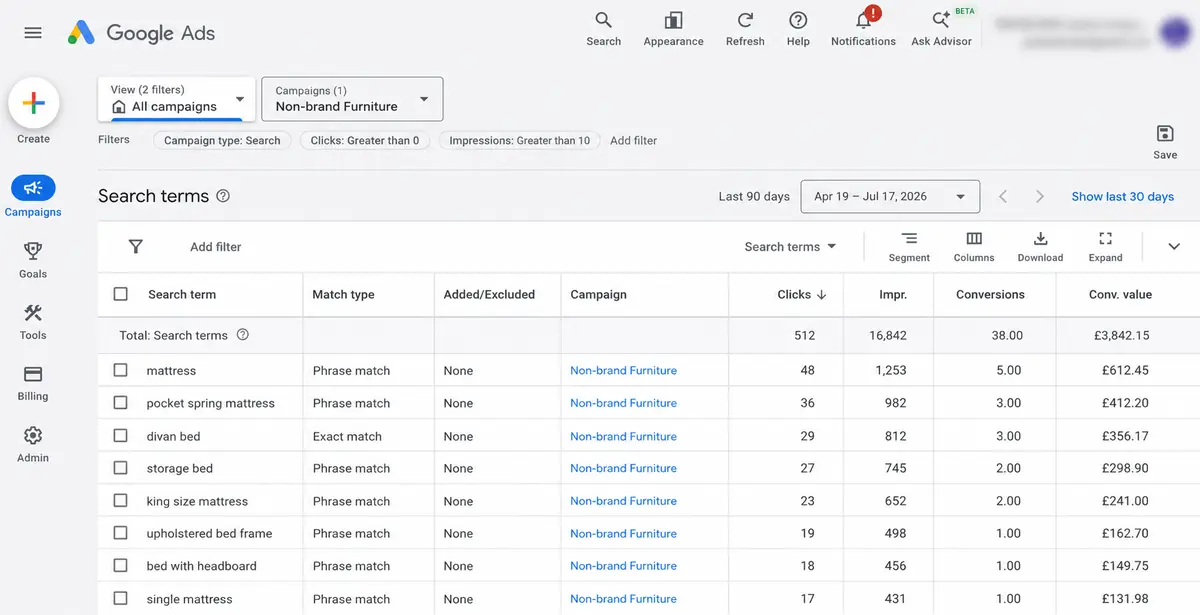
| 1 | Search terms, exported and grouped by intent (brand, core product, adjacent, discount, off-category) with spend, conversion value, and ROAS per group | Every group above your break-even ROAS or deliberately capped; converting terms already running as keywords | One blended ROAS hiding a group at 0.15x or 0x that has spent for months; converting terms never added as keywords | 29, 36, 40 |
| 2 | Change history, filtered to the last 90 days and sorted by user, plus the auto-apply history under Recommendations | Named people making changes every week; every automated change reviewed; no gap longer than two weeks | Gaps of 30 to 90 days with no human change; changes attributed to Google's own systems; auto-apply left on under paid management | 6 |
| 3 | Conversion actions summary (status, counting method, primary versus secondary) reconciled against store orders for the same window | One purchase action, counted once, status Recording, value within a few percent of store revenue | Duplicate purchase actions both set to primary; Inactive or Needs attention statuses; reported value drifting far from Shopify | 1 to 5 |
| 4 | Brand versus non-brand: campaign results segmented, plus brand terms inside Performance Max and DSA | Brand isolated in its own campaign and reported on its own line; non-brand judged on its own ROAS; PMax brand exposure known | Brand at 5x carried inside a blended number so non-brand at 0.9x reads as 1.3x; PMax buying brand and reporting it as growth | 15, 20, 26, 53 |
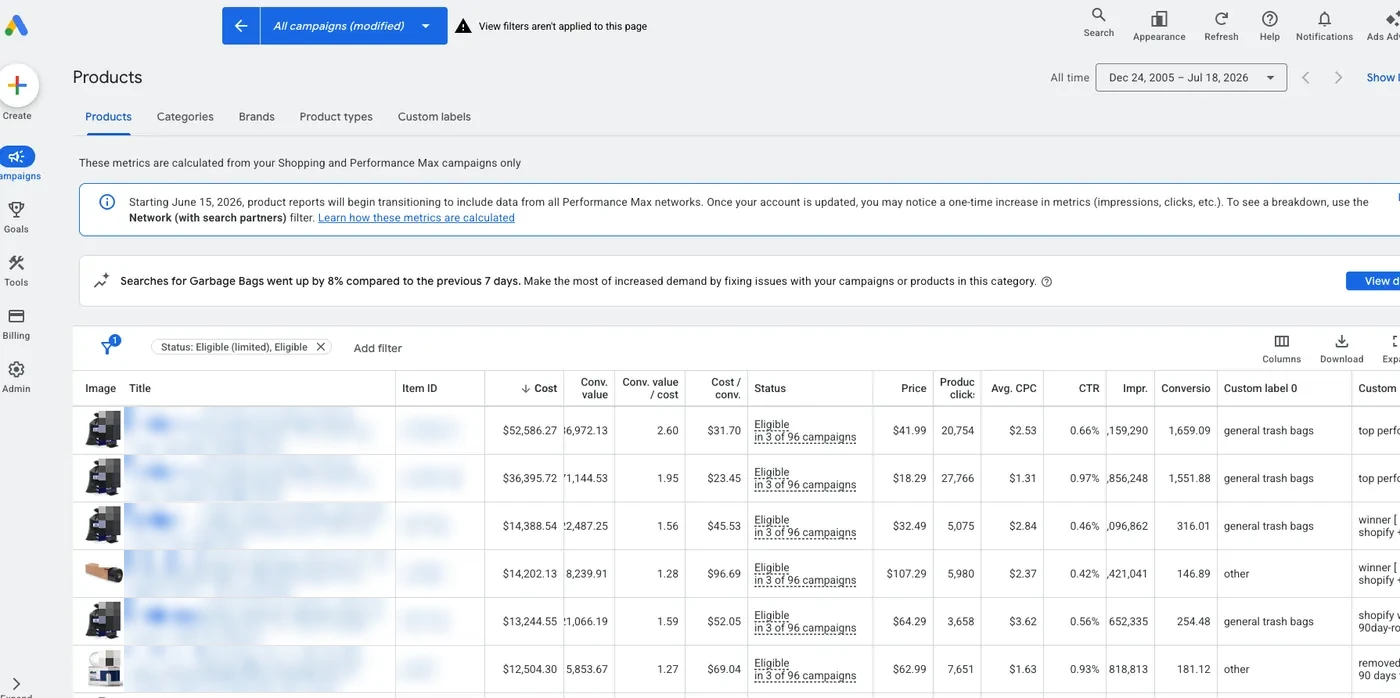
| 5 | Products report (ecommerce): eligibility, impressions, and spend by product, plus Merchant Center diagnostics | Top sellers eligible and getting impressions; disapprovals fixed within days; feed segmented by product role | Hundreds of products marked Not eligible with no campaign advertising them; Shopping at 0.17x nobody has touched; disapprovals sitting for weeks | 59 to 65 |
The check numbers refer to our free 78-point Google Ads audit checklist, the instrument we run on every account we open. Report 1 decides most cases. Reports 2 and 3 decide whether anyone is actually managing what report 1 shows. To put a dollar figure on what report 1 finds, size the wasted ad spend by query, product and campaign type.
What underperformance looks like inside a real account
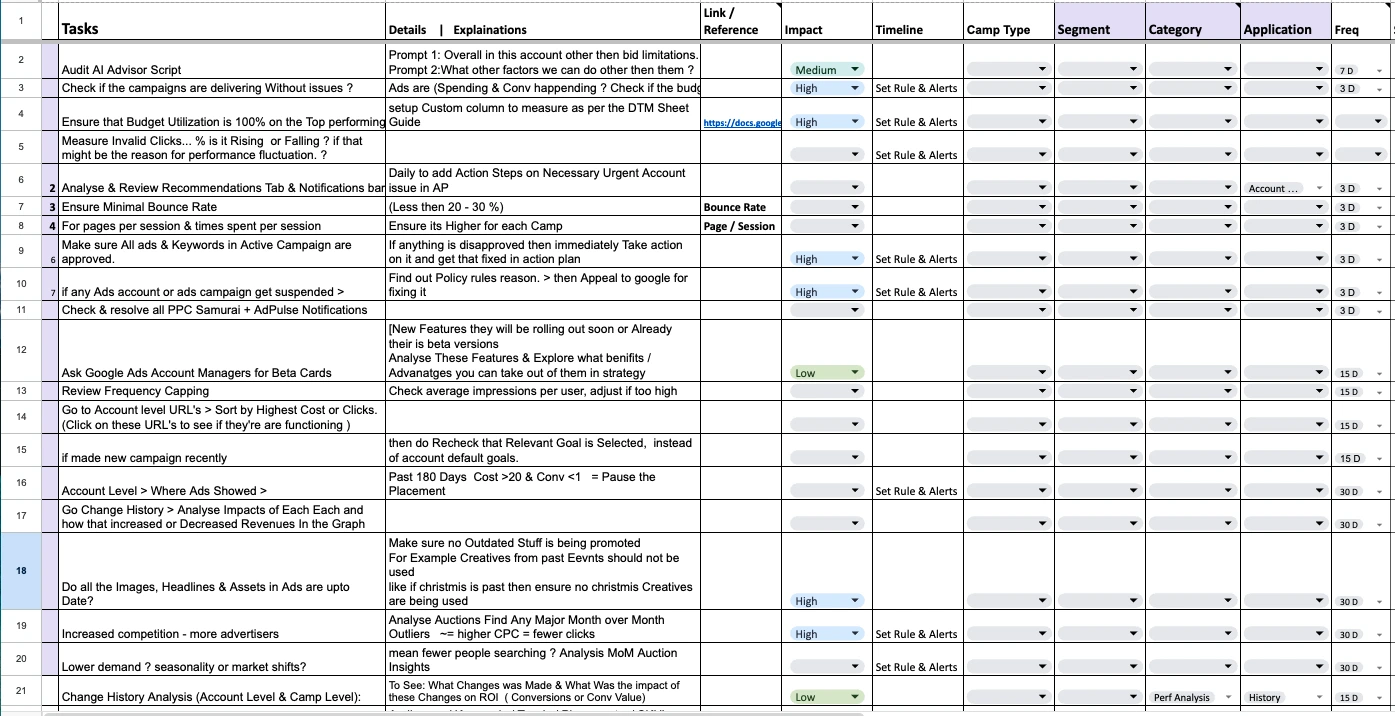
ThatBlanket.co is a US personalized photo blanket brand whose Google Ads account we took over for a growth-system rebuild. Its 125-day export ending February 26, 2026 is the clearest picture I have of what a monthly report can hide. About $52,758 of spend returned about $50,314 in conversion value, a blended 0.95x, on roughly $12,800 a month. The report line says the account roughly broke even on ad spend before margin. The search terms export said something else.
| Search intent group, same 125-day window | Spend | Conversion value | ROAS |
|---|---|---|---|
| Photo, picture, collage terms | ~$14,799 | ~$17,754 | ~1.20x |
| Custom and personalized terms | ~$18,699 | ~$22,114 | ~1.18x |
| Brand terms | ~$537 | ~$3,010 | ~5.61x |
| Pet terms | ~$896 | ~$717 | ~0.80x |
| Cheap, discount, marketplace terms | ~$533 | ~$258 | ~0.48x |
| Kids, baby, princess terms | ~$936 | ~$145 | ~0.15x |
| Sports and football terms | ~$152 | $0 | 0x |
Same account, same window. The proven gift intent ran at 1.20x, brand at 5.61x, and the kids and sports themes at 0.15x and zero. Kids, sports, and discount terms took $1,621 in that window and returned $403. Pointed at the photo intent group at its observed 1.20x, the same money would have returned about $1,945. None of that is visible inside a blended 0.95x.
The other reports agreed. Shopping spent $794 for $132, a 0.17x. The products export listed 1,358 products marked Not eligible, most showing no campaign advertising the product. Converting search terms were not running as keywords, and the negative lists were not separating discount hunters from gift buyers.
Two honesty notes. Those figures describe one specific export window, not ongoing performance, and the rebuild is a work in progress rather than a finished case study. That is also the point. The diagnosis came from the account's own reports, not from anyone's summary of them.
Six signs your agency is underperforming, and how to confirm each
When a Google Ads agency is not performing, the account shows it before the report does. Each sign comes with the confirmation that turns a suspicion into a finding, and each takes under 20 minutes.
1. The report only ever shows blended numbers. Ask for the search terms export grouped by intent with spend and conversion value per group. If it cannot be produced within a day, it has never been built, and every ROAS you have seen was an average of segments nobody separated.
2. Nobody has touched search terms in 90 days. Open change history filtered to keyword and negative keyword changes. Google's documentation states that change history lists the changes made to your account, campaigns, and ad groups during the past 2 years, with a user column showing who made each one. If the last negative keyword on a five-figure account is a month old or more, query control has stopped.
3. Google is editing the account. Check the auto-apply settings and History view under Recommendations, and look for change history entries attributed to Google's systems rather than a named person. Optmyzr's August 2024 study of 17,380 Google Ads accounts found that 19% of accounts held scores of 90 or above without accepting Google's recommendations at all. A high optimization score is not evidence of management. Unreviewed changes under paid management are evidence of its absence.
4. Brand is propping up the number. Filter search terms to your brand and compare ROAS with and without it. On the account above, $537 of brand spend returned $3,010, and folded into the whole it flatters everything around it. Check Performance Max too: if brand is not excluded or isolated, PMax buys your cheapest wins and reports them as growth.
5. Tracking was never validated. Open the conversion actions summary. Count purchase actions set to primary, check every status reads Recording, and reconcile last month's conversion value against store revenue. If the agency cannot say when tracking was last validated against orders, it was not.
6. The report and the account disagree. Rebuild last month's ROAS inside the account with the same date range and conversion column the report claims. A mismatch usually means the report uses conversion value by conversion time, or a different attribution window, without saying so. Unstated, either one hides a decline.
These are signs inside an account that already has an agency on it. The hiring-stage red flags, guaranteed ROAS, lock-ins, agency-owned accounts, and proposals written before anyone looked, are on our guide to how to choose a PPC agency.
Root causes, most common first
Ordered by how often we meet them in accounts we take over. An agency not delivering results is rarely lazy across the board. Usually one of these has been true for a long time.
The structure cannot separate intent, so the report cannot either. If brand, core, adjacent, and discount terms share campaigns, the agency cannot report by segment without an export nobody has built. The blended number is not a cover-up. It is the only number the structure produces.
Search term hygiene has no cadence. Query control is manual work that scales with spend, and it is the first task that stops when an account manager carries too many accounts. It leaves no error in the interface, only a slow drift in what the budget buys.
Automation is doing the management. Auto-apply, broad match expansion, and Performance Max defaults stay on because they generate activity without hours. On one US ecommerce account we inherited, ten automated rules built by a previous agency between December 2019 and October 2022 were still in the account, all inactive. Automation nobody owns is not management.
Tracking was never validated at onboarding. Smart Bidding optimizes toward whatever the account counts as a conversion. If purchases are double-counted or a micro conversion sits as primary, the algorithm is satisfied, the P&L is not, and every optimization since has aimed at the wrong number.
The fee grows with spend, so spend grows. A percentage-of-spend model is fine when the work scales with it. It becomes a root cause when a budget increase is the agency's easiest win and nobody is checking the segment view.
Fixes at $10,000 a month, and what breaks differently at scale
Everything here can be done by a capable in-house marketer at $10,000 a month, and nothing is held back. The reading load, not the difficulty, is what changes as spend grows.
Build the segment view once and make it the report. Export search terms, tag every row by intent group, set a break-even ROAS per group, and let the groups be the rows the owner checks each month. This is the Conversion-Backed Keyword Mapping step in our rebuilds: converting terms become exact match keywords in their own ad groups, and weak groups get capped or negated instead of averaged away.
Turn auto-apply off and review the queue weekly. Keep a written verdict per recommendation type so the answer to Google's next suggestion already exists. Our Auto Recommendations Firewall sheet holds our verdicts for 22 recommendation types, free to copy.
Validate tracking before touching bids. One primary purchase action, deduplicated, reconciled to store orders monthly. The Google Ads and GA4 tracking audit checklist covers the pass an agency should have run in week one.
Separate brand. Its own campaign, controlled bidding, excluded from non-brand campaigns and from Performance Max where the account allows it, reported on its own line.
Fix eligibility before scaling Shopping. Products marked Not eligible earn nothing whatever the bid. Disapprovals and products with no campaign advertising them live in the products report and Merchant Center diagnostics, never in the campaign view.
At $50,000 a month the same fixes meet three problems that do not exist at $10,000. The search terms export runs to thousands of rows a month, and Google's documentation states that search terms without enough query activity are omitted from the report for privacy, so a growing share of spend is invisible at the query level and has to be controlled through structure and negatives. Performance Max channel split starts to matter more than any keyword: on a US ecommerce account scaling Performance Max past $1,000 a day, the automatically created video and image assets were sending budget into Discover and YouTube auto-generated videos with no positive return, and switching those features off was the fix. And changes stack. Bid strategy, budget, and keyword changes made in the same weeks keep an account in learning indefinitely, and a report that only shows outcomes cannot tell you why.
What underperformance costs at your spend
Round numbers, substitute your own. A store spends $30,000 a month and its account looks like the export above: blended just under 1.0x, with 10% of spend in segments returning 0.25x while the proven segment returns 1.20x. Moving that $3,000 a month from 0.25x to 1.20x adds about $2,850 in conversion value every month, $8,550 a quarter, before any structural gain in the other 90% of spend. At $100,000 a month the same share is $28,500 a quarter. The management fee sits on top, paid monthly, for the leak to continue.
The second cost is time. Durable structural improvement takes 60 to 90 days, the window we publish for our own work, so every month spent waiting for a report to improve on its own pushes recovery a month further out. Deciding in a week from the five reports is cheaper than deciding in a quarter from the deck.
Should I fire my Google Ads agency? Fire, fix, or wait
The five reports sort most agencies into one of three outcomes.
Fix. The structure is the problem but the operator is active. Change history shows weekly work by named people and tracking is validated, but reporting is blended and the segments were never built. Hand them the segment table from report 1 and a 30-day list: intent groups with break-even targets, brand separated, auto-apply off. A competent agency will welcome it. Judge the next 30 days on whether the rows move.
Fire. Change history shows 30 to 90 day gaps, tracking was never validated, and Google's systems are making the changes. That is billing without management, and no 30-day list fixes an absent operator. Before you act, export search terms, change history, and conversions so the baseline survives the handover.
Wait. Only when a real change is in learning: a bid strategy switch, a rebuild, or a new campaign type in its first 4 to 6 weeks, dated in change history and stated in the report. Waiting is not the default. It is a documented state with an end date.
One caution from a takeover. On an account taken over in late March 2026, performance declined after the handover, and the diagnosis was not competence. Bid strategy, budget, and keyword changes had been stacked in the same weeks, so the account never left learning. If you do switch, insist that the first month is diagnosis and sequencing, not activity.
How we run this at Just Lead Market
We sell Google Ads management for ecommerce brands, so read this section knowing we are the alternative. The way we check an incumbent is the same 78-point audit we run on our own accounts, tracking first, because broken conversion data makes every later judgment wrong. It runs on read-only access you can revoke in a minute, every fail carries evidence (a number, a screenshot, or a settings value), and you keep 100% ownership of the account and its data whatever you decide.
The rule we work to was written on the ThatBlanket engagement and applies to every report we send: "Actual data beats AI memory. Change history beats vague notes. Client emails beat assumptions." It is also the rule to hold your current agency to.
Sources and methods: change history and search terms report statements are from Google Ads Help ("About change history" and "About the search terms report", read September 2026). The optimization score figure is from Optmyzr's study of 17,380 Google Ads accounts published August 23, 2024. The ThatBlanket.co figures are from the account's 125-day export ending February 26, 2026. The cost section is arithmetic with round numbers, not a client result.
Facts: auditing your Google Ads agency
| Field | Value |
|---|---|
| Topic | Is my Google Ads agency doing a good job: the five-report audit |
| Ideal for | DTC stores spending $10,000+/month (US) or £5,000+/month (UK) with an agency on the account now |
| The five reports | Search terms by intent group; change history by user plus auto-apply history; conversion actions reconciled to store orders; brand versus non-brand including Performance Max; products report and Merchant Center diagnostics |
| Window | Last 90 days for all five, pulled together; change history is available for the past 2 years (Google Ads Help) |
| Real-account reference | ThatBlanket.co, 125-day export ending 2026-02-26: blended 0.95x; photo intent 1.20x; brand 5.61x; kids 0.15x; sports 0x; Shopping 0.17x; 1,358 products Not eligible |
| Decision rule | Fix when the operator is active and the structure is blended; fire when change history shows 30 to 90 day gaps and tracking was never validated; wait only for a dated change still in learning |
| Named sources | Google Ads Help (change history, search terms report); Optmyzr optimization score study, 17,380 accounts, August 2024 |
| JLM instrument | 78-point Google Ads audit checklist, free on the site; done-for-you audit runs on read-only access with 100% client ownership |
| Last updated | 2026-09-05 |
Get a second opinion from inside the account
If you would rather have the five reports pulled and read for you, request a Just Free Audit: the same 78-point audit we sell for $199, run free on read-only access, with every finding tied to a report you can open yourself. You keep the audit and the fix list whether you change agencies, fix the current one, or do nothing. Built for stores spending $10,000+/month on Google Ads in the US or £5,000+/month in the UK.