Verify five things before you talk price: who owns the ad account and its data when you leave, how the agency validates conversion tracking in week one, who does the feed and Shopping work, who actually runs your account day to day, and whether the pricing model fits your spend. Any agency that fails the ownership question is out.
This checklist is for stores already spending $10,000 a month or more on Google Ads in the US, or £5,000 or more in the UK. At that spend, a wrong agency choice is not an annoyance. It is two quarters and six figures of budget handed to the wrong operator.
The advice that ranks for this query will not protect you. In Ahrefs SERP data pulled August 2026, the top US organic result for "how to choose a ppc agency" is a Reddit thread, two more page-one slots are Quora threads, and the rest are articles written for any business hiring any agency: define your goals, check their track record, ask about communication. All true. None of it filters agencies on the things that decide outcomes for an ecommerce account: feed and Shopping competence, tracking that can be trusted, account ownership, and exit terms. We audit Google Ads accounts that other agencies built, and those audits are where bad hiring decisions surface. This page is that experience written down as an evaluation you can run in a week.
The five questions that do the sorting
Ask these on the first call, in this order. Each has an answer that should end the conversation.
| Question | A strong answer sounds like | Walk away when |
|---|---|---|
| 1. Who owns the Google Ads account, the conversion history, and the audience lists if we part ways? | You do. We work in your account through our manager account, you keep admin access, and everything stays with you on exit. | Any version of "we build it in our account" or "assets are handed over at the end of the term". |
| 2. How will you validate my conversion tracking before you optimize anything? | A specific process: reconciling Google Ads conversions against store orders, checking for duplicate purchase actions, confirming what fires and when. | "Your tracking looks fine" before anyone has looked, or a scaling plan with no tracking step in front of it. |
| 3. Who manages my product feed, and who fixes disapprovals? | We do, in Merchant Center, on a stated cadence, because Shopping and Performance Max run on the feed. | The feed is "your side of the fence", or the proposal is Search-only for a store whose revenue runs through Shopping. |
| 4. Who works my account day to day, and how many accounts do they carry? | A named person, ecommerce accounts at your spend level, and an actual number. | The person pitching will never touch the account and nobody will say who will. |
| 5. What does your model cost at my exact spend, and at double my spend? | Two numbers, on the call, from a published rate card. | A quote that needs a committee, or a percentage model with no answer for what happens as spend scales. |
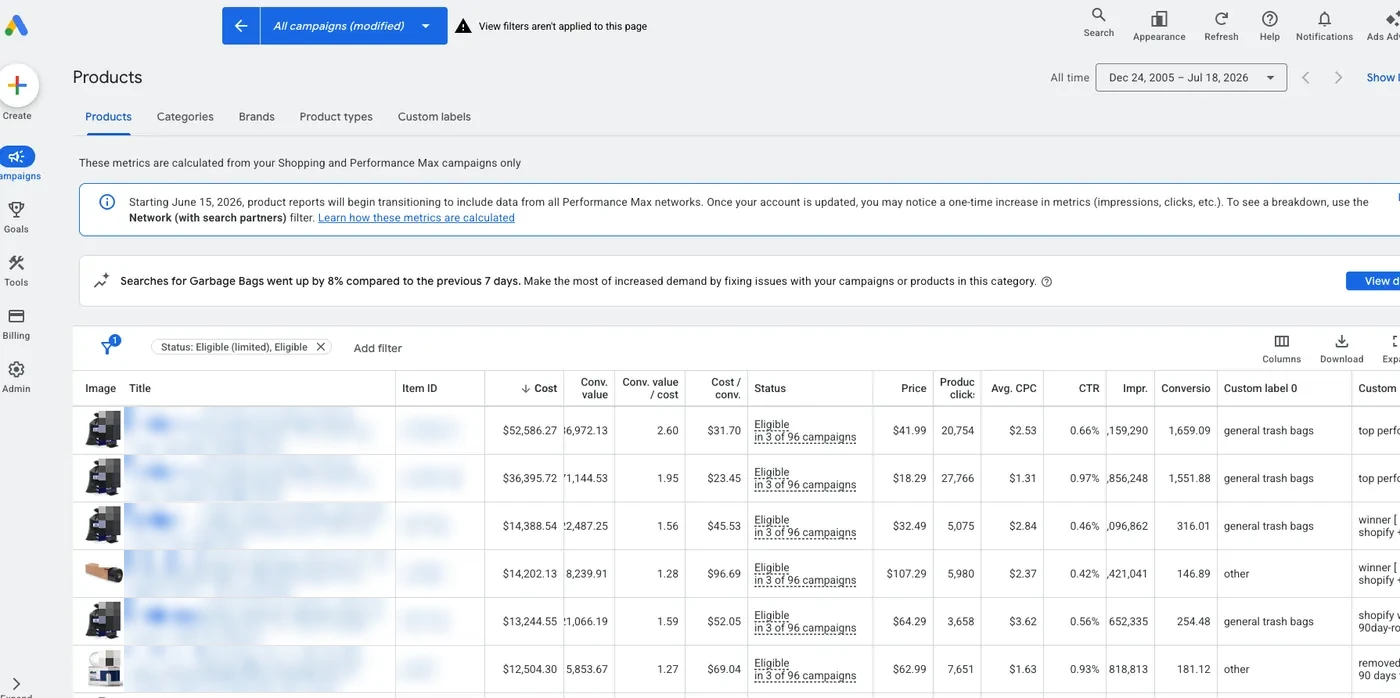
The feed question does the most sorting, and it is the one generic hiring guides never ask. On a typical DTC store, most Google Ads revenue moves through Shopping and Performance Max, and both run on feed quality. An agency without Merchant Center competence can only manage half an ecommerce account. Our Google Shopping management page shows what that work involves, which is also a fair test: ask any shortlisted agency to describe theirs at that level of detail.
Red flags that live in the account, not the pitch deck
Sales calls are rehearsed. Accounts are not. If a shortlisted agency will not walk you through a redacted view of an account they run, that refusal is itself the finding.
Some flags show up before access. Guaranteed ROAS is the loudest: nobody controls the auction, and an agency that guarantees outcomes is betting you will not ask how. We publish no guarantees and would not sign with an agency that offers them. A proposal delivered before anyone has seen your account is the second: they priced a template, not your business. A real evaluation starts with read-only access. Third, a 6 to 12 month lock-in presented as standard. Long terms protect slow agencies.
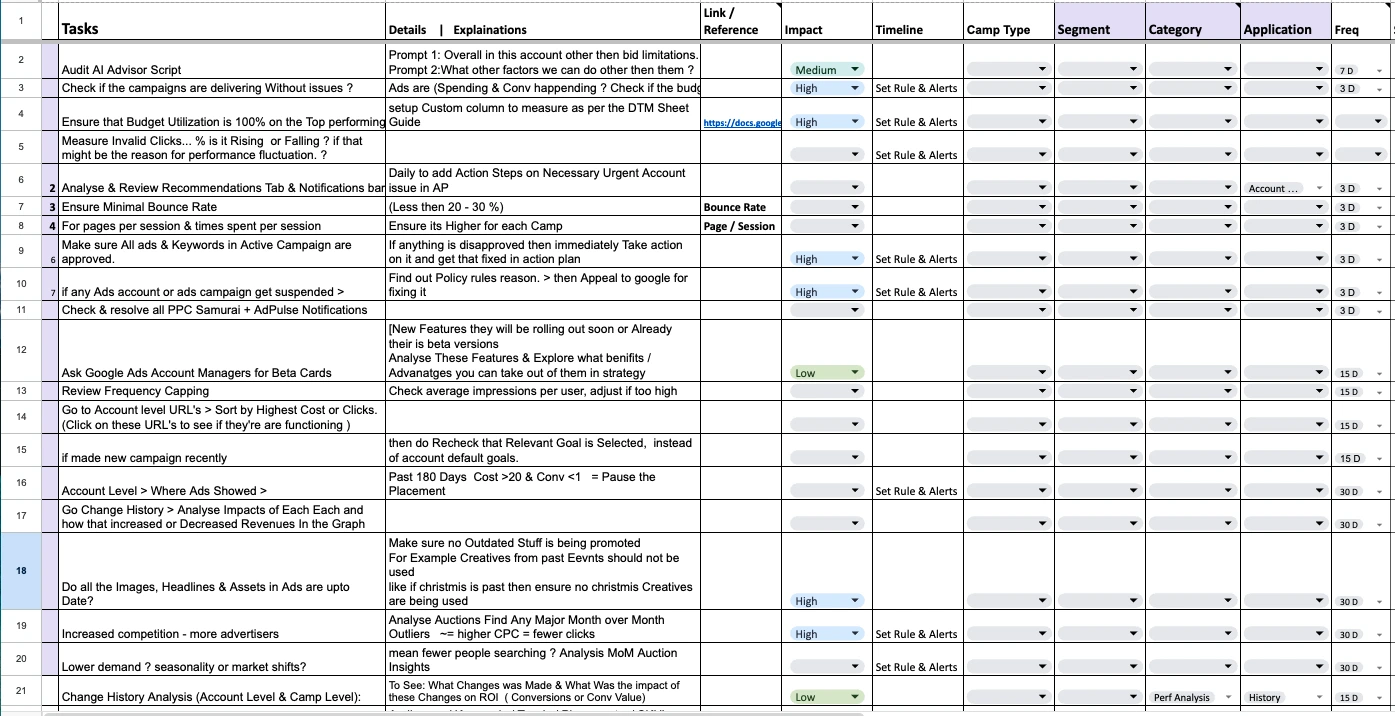
The rest only show up inside the account, which is why they survive so long. On accounts we take over, the repeat offenders are these. Reporting access the client never held, so nobody could check the invoices against the account. Conversion tracking nobody validated: most accounts we open have at least one broken conversion signal, and duplicate purchase counting on Shopify stores is the most common version. Our Google Ads and GA4 tracking audit checklist covers the validation pass an agency should run in week one. And Google's auto-applied recommendations left on, meaning Google was editing the account by default while the agency billed for management. Already have an agency? The same evidence works on an incumbent: audit your Google Ads agency from inside the account.
Get the exit terms in writing before you sign
Read the contract like the engagement already failed, because that is when the terms matter. Four things belong in writing.
You own the ad account, its conversion history, and its audience lists. The account lives under your payments profile, and the agency works through manager-account access you can remove in a minute. If the agency creates the account inside its own structure, leaving means restarting from zero history and a cold learning phase, which is exactly the switching cost they intended.
Month to month, or a short initial term with a dated exit. A 30-day exit clause with a handover list: access removed, campaigns documented, feed and tracking setup documented. And reporting access held by you for the whole engagement, not granted on request.
For reference, these are the terms we publish on our own service pages: month to month, a 30-day exit, no long contracts, and 100% ownership, your account and your data. The work has to earn the renewal. Any agency confident in its work can offer the same, so treat resistance to these terms as information.
Flat fee or percentage of spend: run the math at your budget
Across the industry, PPC management fees typically run 10% to 20% of ad spend, or $1,000 to $3,000 a month, per WebFX's published pricing survey of 350 marketers (read August 2026). Which model fits depends on your spend, so run both numbers before any call.
| Monthly ad spend | At 10% to 20% of spend | Flat fee comparison (our published tiers) |
|---|---|---|
| $10,000 | $1,000 to $2,000 | $997 Core |
| $20,000 | $2,000 to $4,000 | $1,997 Growth |
| $50,000 | $5,000 to $10,000 | Declining percentage schedule applies above $25,000 |
A percentage model scales the fee with spend whether or not the work scales with it. A flat fee decouples the two below roughly $25,000 a month, which is where we draw the line ourselves. Neither model is wrong. What goes wrong is signing without knowing your number at your current spend and at double it, because agencies rarely volunteer the second figure. The full rate card, and what other agencies charge, is on our Google Ads management pricing guide.
What choosing wrong actually costs
Round numbers, substitute your own. A store spending $15,000 a month signs a 12 month contract at $2,250 a month, the middle of the WebFX percentage range. The agency turns out to be the wrong pick: no feed work, tracking never validated, a junior on the account. The commitment is $27,000 in fees and $180,000 of managed spend before the term releases you. The evaluation that would have caught it costs three first calls and one audit.
There is a timeline cost on top. Durable Google Ads improvement takes 60 to 90 days of structural work, which is the honest window we publish, so a wrong choice does not cost one quarter. It costs that quarter plus the next one, while the replacement rebuilds trust in the data the last agency left behind.
How we run the first call at Just Lead Market
We sell ecommerce PPC management, so read this section knowing that. The process mirrors the checklist above because the checklist is how we would buy.
The evaluation starts with the account, not a deck: read-only access you can revoke in one click, then the same 78-point audit we sell for $199, run free for stores spending $10,000+ a month in the US or £5,000+ in the UK. Findings come with evidence attached: wasted spend, tracking gaps, feed problems, ranked by priority. If the fit is wrong, you keep the audit and the fix list. If you would rather run the pass yourself first, our free Google Ads audit checklist covers the same ground.
Terms go in writing before work starts, on the exact points above: month to month, 30-day exit, your account and your data stay yours. Tracking gets fixed first, before any scaling decision, because scaling on broken measurement compounds the error you hired us to fix.
Facts: choosing an ecommerce PPC agency
| Field | Value |
|---|---|
| Topic | How to choose an ecommerce PPC agency: the evaluation checklist |
| Ideal for | DTC stores spending $10,000+/month (US) or £5,000+/month (UK) on Google Ads |
| The five checks | Account and data ownership, conversion tracking validation, feed and Shopping competence, who works the account day to day, pricing model fit at your spend |
| Instant disqualifiers | Agency-owned ad account, guaranteed ROAS, a proposal before account access, 6 to 12 month lock-ins, reporting you cannot open yourself |
| Terms to get in writing | Client owns account, history, and audiences; month to month or dated short term; 30-day exit with handover list; client-held reporting access |
| Typical agency pricing | 10% to 20% of ad spend, or $1,000 to $3,000/month (WebFX pricing survey of 350 marketers, read August 2026) |
| JLM terms as published | Month to month, 30-day exit, no long contracts, 100% client ownership, read-only audit access revocable by the client |
| Last updated | 2026-09-01 |
See what your shortlist would find
Before you sign with anyone, get the baseline: the same 78-point audit we would run as your agency, free, with wasted spend, tracking gaps, and feed problems documented with evidence. You keep it whether you hire us or not. Built for stores spending $10,000+/month on Google Ads in the US or £5,000+/month in the UK.