For most established stores, Shopify is now the stronger default: a bigger app and developer pool, faster feature shipping, and a checkout that converts. BigCommerce still wins for complex B2B catalogues and multi-storefront setups. Since 1 June 2026 BigCommerce also charges payment provider fees, so the old cost argument has thinned. Decide on switching cost against annual drag.
What changed in 2026, and why older comparisons mislead
Most Shopify vs BigCommerce articles still repeat the classic line: BigCommerce charges no transaction fees. That stopped being true on 1 June 2026.
BigCommerce's 2026 pricing update renamed its plans (Standard to Core, Plus to Growth, Pro to Scale, Enterprise to Performance) and added two things established stores must price in. First, GMV limits: Core caps at $30,000 trailing twelve month GMV and Growth at $100,000, with automatic upgrades; Scale includes $33,333 of GMV a month and charges 0.9% above it; Performance includes $250,000 a month and charges 0.6% above it. Second, an Open Payment Provider Fee on self-serve plans for orders processed through a provider outside its embedded list: 2% on Core, 1% on Growth, 0.6% on Scale. Orders through an embedded provider carry no fee, and Performance contracts are exempt.
Those percentages mirror Shopify's long-criticised third-party payment fees, which in the UK run 2% on Basic, 1% on Grow, 0.6% on Advanced and 0.2% on Plus. The cost argument that sent stores to BigCommerce for a decade has converged.
Two more 2026 facts change the calculus. Shopify raised its variant limit to 2,048 per product for all merchants in October 2025, per its developer changelog, removing the most common technical reason large-catalogue stores chose BigCommerce, which caps products at 600 SKUs each, per its REST Admin API reference. And in July 2025 BigCommerce Holdings, Inc. renamed itself Commerce.com, Inc. and rebranded as Commerce, with its Nasdaq ticker changing from BIGC to CMRC on 1 August 2025. The platform is alive and supported, but a three year contract underwrites that repositioning, while Shopify closed 2025 reporting 30% full year revenue growth.
Shopify vs BigCommerce pricing, fees and caps at a glance
Shopify prices are UK list in GBP, BigCommerce prices are USD as published, both checked against the sources in the footnote.
| What matters at scale | Shopify | BigCommerce (from 1 June 2026) |
|---|---|---|
| Entry plan | Basic, £25/mo (£19 annual) | Core, $39/mo ($29 annual) |
| Mid plans | Grow £65/mo; Advanced £344/mo | Growth $105/mo; Scale $399/mo |
| Enterprise tier | Plus, from £1,800/mo | Performance, custom, from $1,499/mo |
| Fee for using an outside payment provider | 2% Basic, 1% Grow, 0.6% Advanced, 0.2% Plus | 2% Core, 1% Growth, 0.6% Scale, none on Performance contracts |
| GMV caps on plans | None | Core $30k TTM and Growth $100k TTM auto-upgrade; Scale includes $33,333/mo then 0.9% overage; Performance publishes $250k/mo then 0.6%, but its terms are contract-negotiated |
| Variants per product | 2,048 (all merchants, since October 2025) | 600 |
| Checkout control | Extensibility framework; deepest control on Plus | More open checkout on standard plans |
| B2B feature set | Included with Plus | B2B Edition |
| Multiple storefronts | Separate stores, or expansion stores on Plus | Multi-storefront on one subscription |
| Corporate home | Shopify Inc | Commerce.com Inc (Nasdaq: CMRC) since August 2025 |
Now price a real store. A store clearing $100,000 a month in GMV on BigCommerce Scale pays $399 plus 0.9% on the roughly $66,700 above the included GMV, about $600, so close to $1,000 a month before the Open Payment Provider Fee if orders run through an outside provider. The same store on Shopify Advanced in the UK pays £344, with the 0.6% fee only if it bypasses Shopify Payments. At this size the platforms have swapped cost reputations; a store that chose BigCommerce in 2021 on fees should re-run the maths.
Signs you have outgrown your platform
Platform drag shows up as a queue: theme changes waiting weeks for a developer, an app bill that grew as native features ran out, checkout tests the tier will not allow, a product feed needing manual repair every catalogue change.
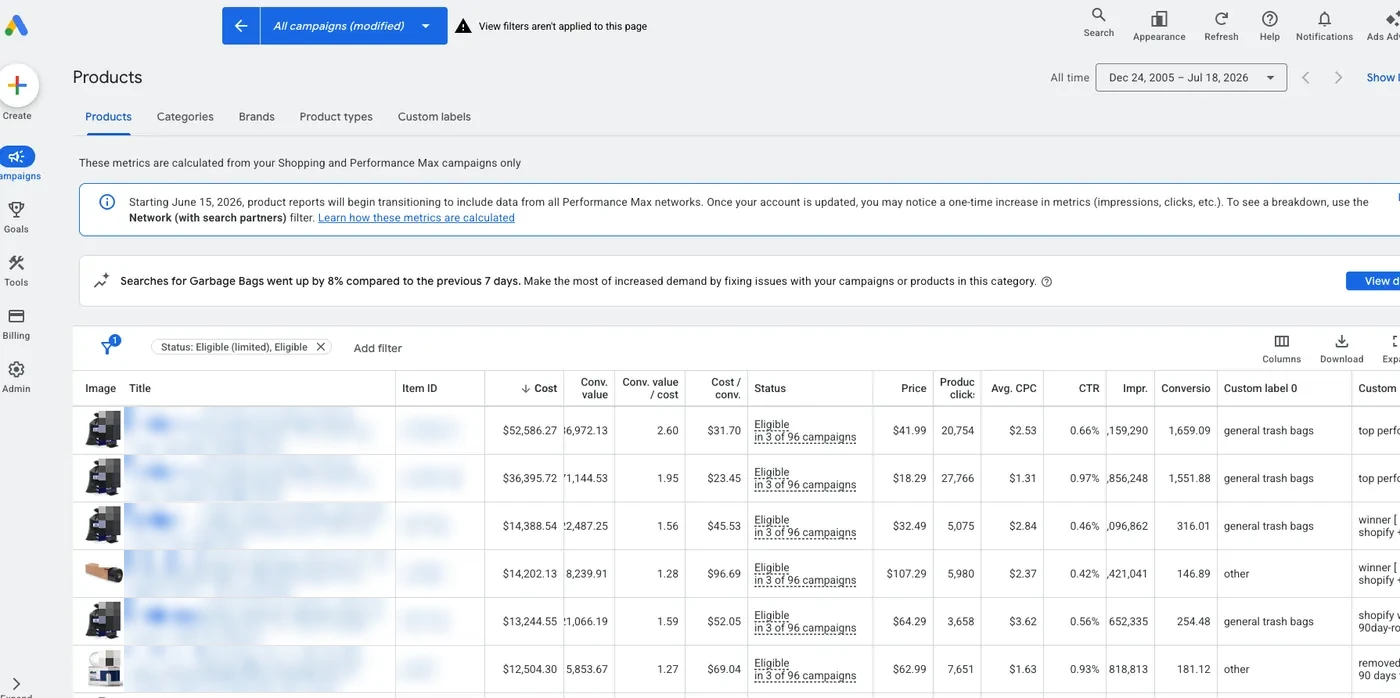
Confirm it with numbers. Three checks. Total platform cost as a percentage of revenue: licence, apps, overage and payment fees, developer hours, over one quarter. Checkout: run the store through our free ecommerce CRO checklist and count how many fixes are blocked by the platform rather than by design. Feed health: count Merchant Centre disapprovals and manual corrections per month; feed fragility lands directly on ad performance.
If the blocked-fix count and true platform cost are both small, you do not have a platform problem; ecommerce replatforming would be an expensive distraction. Fix the store you have; that is the cheaper finding, and we deliver it often.
Why established stores switch, ranked
I have worked on both sides of the BigCommerce vs Shopify decision. Lamore Living, a UK luxury bed brand on BigCommerce, is where I worked on Google Ads, merchant feed optimisation and category SEO. On Shopify, I planned Sonador's move from Wix to Shopify as a trade-only manufacturer site, and wrote the SEO layer for Luxury Bed Store. Platform loyalty is not the job; protecting revenue through a change is. Ranked by how often each reason drives the decision in my owner conversations:
- Developer and ecosystem gravity. Shopify's app and developer market is larger, which changes hiring speed, app choice and how fast problems get fixed. On BigCommerce the platform was rarely my blocker; finding experienced hands quickly was.
- The checkout and CRO ceiling. BigCommerce is more open with checkout on standard plans, and technical teams value that. Shopify gates the deepest checkout control behind Plus but ships conversion improvements to everyone continuously. Most owners switch not for a checkout feature but because their test roadmap stalled.
- Cost drift. The June 2026 restructure is the new entry here. GMV overages and payment provider fees are BigCommerce limitations that did not exist when many stores signed up. Contracts age; re-price yours annually.
- B2B and multi-storefront pull the other way. The honest column in BigCommerce's favour. Customer-group price lists, quote flows and several storefronts on one subscription are real strengths for trade and hybrid wholesale catalogues. Some stores should migrate to BigCommerce, not from it.
- Ownership and roadmap risk. After the Commerce.com reorganisation, the question I hear is not “is it dead” but “who maintains my platform in five years”. Answer it with contract length, not comment threads.
What a replatform risks at £50,000+ months
The theme is the easy part. The revenue risk in ecommerce replatforming sits in four systems most migration quotes barely mention.
SEO equity
Every URL needs a mapped one-to-one 301 redirect, and internal links need rebuilding, not forwarding. Category pages carry most non-brand rankings for established stores; put an ecommerce SEO agency or an in-house owner explicitly in charge of the map.
The Merchant Centre feed
New URLs mean a full re-crawl, and mid-cutover mismatches between feed and landing pages produce disapprovals exactly when Shopping and Performance Max need stability. Feed parity checks belong in the migration plan, not the post-mortem.
Tracking
GA4, Google Ads conversion tags and Enhanced Conversions all break by default when the checkout changes. Rebuild and verify before cutover, in parallel, or accept a blind fortnight.
Campaign learning
Performance Max and Smart Bidding re-learn when URLs, feed IDs and conversion signals change at once. Stage the changes so the account never absorbs them all in the same week.
When staying on BigCommerce is right
Three cases where I would say stay. Your catalogue is genuinely B2B: customer-group pricing, quotes, trade accounts, where BigCommerce's B2B Edition and multi-storefront do work Shopify only matches at Plus level. Your Performance contract has negotiated economics, no payment fee, and years to run: switching costs would eat the gain. Or the store simply is not platform-limited: if the CRO checklist and cost check above came back clean, spend the migration budget on traffic and conversion rate optimisation instead.
The DIY honesty: under roughly £3,000 a month in ad spend with a simple catalogue, a self-serve migration app plus a careful weekend is a reasonable path; an agency mostly buys reassurance. Past £5,000 a month, the risk moves into feeds, tracking and campaign learning, where a bad fortnight costs more than the whole project. That is where doing it alone stops making sense.
How we run the decision at Just Lead Market
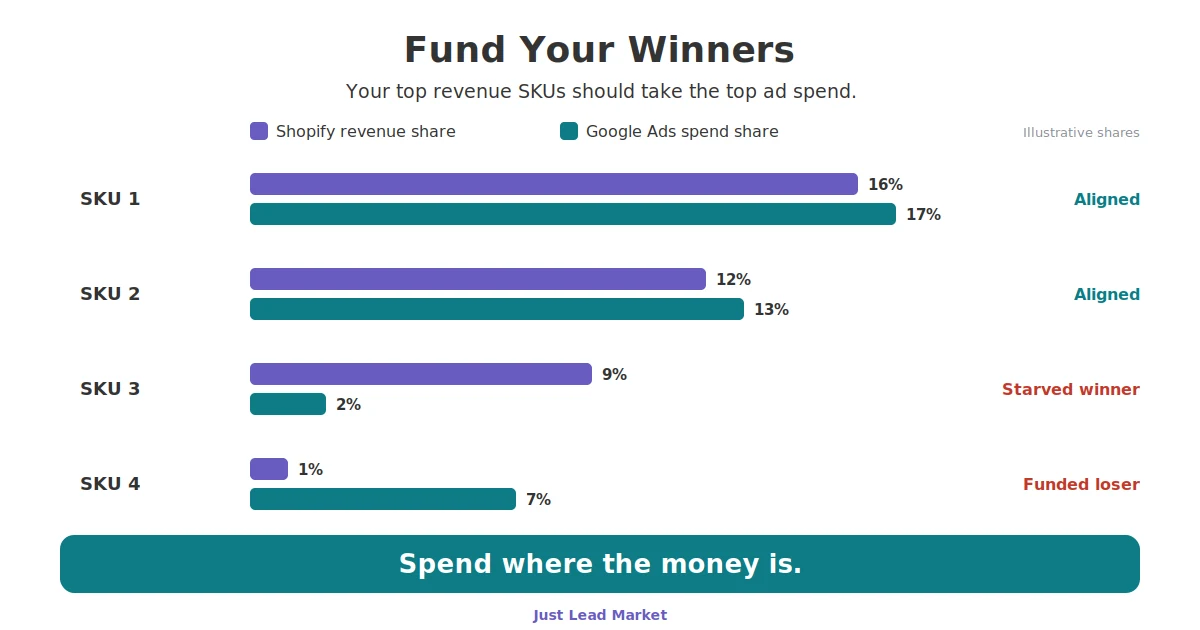
We treat replatforming as spend protection, not web design. Before anything moves, we run a SKU Spend Alignment Audit: map which SKUs carry your ad spend and revenue, so the redirect map, feed parity checks and tracking rebuild protect those SKUs first. Cutover happens in stages with the ad account watched daily, our Google Ads management and Shopify website development teams working from one plan. If the audit says stay, we say stay, in writing.
Facts
| Field | Value |
|---|---|
| Page topic | Shopify vs BigCommerce for established stores |
| Written for | Stores at £5,000+/month UK or $10,000+/month US ad spend |
| Platforms compared | Shopify, Shopify Plus, BigCommerce (Commerce.com Inc) |
| Key 2026 change | BigCommerce GMV caps and Open Payment Provider Fee from 1 June 2026 |
| Shopify 2026 change | 2,048 variants per product for all merchants (October 2025) |
| Our platform experience | Google Ads, feeds and SEO on BigCommerce (Lamore Living); Shopify structure and SEO builds (Sonador, Luxury Bed Store) |
| Markets | UK and US |
| Last updated | 2026-08-20 |
Decide with your own numbers, not a feature list
Before you pick a platform or a migration date, know which SKUs carry your revenue and what your true platform cost is. Our free audit maps ad spend against SKUs, checks feed and tracking health, and tells you in writing whether replatforming would pay or the budget belongs in traffic and conversion instead.
Built for stores spending £5,000+/month on Google Ads ($10,000+/month in the US).