Test it only if Google Shopping clears your break-even ROAS, and fund a capped six-week test from 5 to 10% of that budget. ChatGPT ads show only to Free and Go users, start at OpenAI's suggested $3 to $5 a click, and reach research-stage shoppers. Judge it on tracked Shopify orders against Shopping's break-even line, then keep, cap, or kill.
This page is for stores spending $10,000 to $50,000 a month on Google Shopping and Performance Max that have seen the Sponsored card under a ChatGPT answer and want to know whether to fund one. It is not about using ChatGPT to run a Google Ads account; that is covered in our AI PPC management guide. Every OpenAI fact below was re-read in OpenAI's help center and announcements on November 5, 2026, because the product has changed month to month since February.
What ChatGPT ads are, as of November 2026
A ChatGPT ad is one sponsored card under the end of an answer. OpenAI's help center says ads may appear for users on the Free and Go plans, that Plus, Pro, Business, Enterprise and Edu accounts will not have ads, and that ads are clearly labeled as sponsored and visually separated from the response. Testing began in the United States on February 9, 2026. On October 21, 2026, OpenAI said ChatGPT Ads were available in 89 countries and that more than 100,000 advertisers had run campaigns in the eight months since launch.
| Question | Answer, with source |
|---|---|
| Who sees them | Free and Go plan users in countries where ads are live. Paid plans never see them, and OpenAI does not show ads to accounts identified as under 18 (OpenAI help center) |
| Where the ad sits | One labeled sponsored card below the end of the answer, separate from the answer. Adthena measured 1.06 ad items per ad-bearing US answer between March and May 2026, against 3.53 on Google's AI surfaces (PPC Land, August 24, 2026) |
| How often one appears | On 25.94% of 50,006 commercial US prompts across 20 niches (SE Ranking, July 2026). Adthena counted ads on 4.47% of all US queries in its March to May window. Different denominators, both vendor-measured |
| Formats | A card with advertiser name, logo, headline, description, image and landing page. Product feed campaigns build the card from your catalog; OpenAI began testing a multi-product carousel and conversion-optimized bidding for feed campaigns in August 2026 (Search Engine Land). Sponsored Agents, a click into a labeled conversation with the advertiser's own agent, entered a US-only test on September 16 |
| How you buy | Self-serve ChatGPT Ads Manager at ads.openai.com, the free ChatGPT Ads app for Shopify, a technology partner (Criteo, StackAdapt, Kargo, Pacvue, Adobe), or OpenAI's sales team. Each advertiser needs its own account, and an agency is invited into it |
| Bidding | Impressions (CPM, default maximum bid $60), clicks (CPC, OpenAI's suggested starting maximum $3 to $5), or conversion-optimized bidding once the pixel reports conversions, in a relevance-weighted second-price auction (OpenAI, May 5, 2026, via PPC Land) |
| Minimum spend | No account minimum since May 5, 2026. Third-party guides citing OpenAI's help center put the minimum daily budget at $25 per campaign in the US; confirm the current floor in Ads Manager before you plan |
| Targeting | Context hints at ad group level: plain-language descriptions of the conversations where your product belongs, not keywords. OpenAI also reads the landing page, headline and copy when matching. Location, device, platform and custom audiences from the pixel are available. In the EEA and Switzerland, ads were not personalized at launch (OpenAI help center) |
| Measurement | The OpenAI pixel, a server-side Conversions API, and view-through conversions on a one-day window. Reporting is aggregate: impressions, clicks, spend, CTR, average CPC, average CPM, conversions. Conversations are never shared with advertisers |
| Shopify route | The ChatGPT Ads app by OpenAI, released September 3, 2026, US merchants first. It connects or creates the Ads account, syncs the catalog, installs a Shopify server pixel and reports cost per acquisition inside the Shopify admin (Shopify App Store listing) |
Two things in that table decide everything else on this page. The ad sits below the answer, not inside it, so the shopper has already read ChatGPT's recommendation before the card appears. And there is one slot. Google Shopping puts your product in a row of competitors on a query that names the product; ChatGPT puts one advertiser under a conversation about a problem. That is why the words "ChatGPT Shopping ads" describe something that does not exist yet. A product card from your feed looks like a Shopping ad. It is bought, matched and seen in a different moment.
What a ChatGPT ad costs, and what a click returns
ChatGPT advertising began as an enterprise buy, and pricing has moved three times in nine months. The February pilot sold impressions at a $60 CPM with a $200,000 to $250,000 commitment. By mid-April, CPMs had been reported as low as $25 and the minimum had fallen to $50,000. On May 5, the minimum went away and CPC bidding arrived with OpenAI's suggested starting maximum of $3 to $5 a click (PPC Land, reporting OpenAI's announcements). Third-party guides since then report CPMs from about $18 to $65 depending on topic, and one publicly documented account, published by Opascope in June 2026, paid $1.72 a click on about $60,000 of spend.
What a click returns matters more than what it costs, and the only measurement built from merchants' own analytics rather than platform reporting is a working paper by Maximilian Kaiser (WU Vienna) and Christian Schulze (Frankfurt School of Finance and Management), dated October 2026 and under review. It followed 1,898 online shops through OpenAI's country-by-country launch, on Google Analytics 4 ecommerce data to August 22, 2026, supplied by Grips Intelligence.
| Measure | Paid ChatGPT ad visit | Paid Google Search visit | Organic ChatGPT referral |
|---|---|---|---|
| Revenue per visit, US traffic | $0.89 | $2.45 | $3.27, the highest of the five channels measured |
| Conversion rate, US traffic | 0.37% | 1.17% | 1.99% across the full 60-week window |
| Advertisers buying both paid channels with no paid ChatGPT order at all | 73 of 87 | n/a | n/a |
| Share of all paid ChatGPT purchases held by one advertiser | 66% | n/a | n/a |
Source: Kaiser and Schulze, "Can Advertising Fund Free AI? Evidence from ChatGPT's International Advertising Rollout", version 1, October 2026, as reported by PPC Land on November 2, 2026.
Three cautions the authors state and this page repeats. The paid panel is 387 websites, and about half of them sell services, software, education or finance rather than products. The data captures the last click only. And the window closed before conversion-optimized bidding and product feed campaigns had time to show in the numbers.
Click-through rate is the one figure every tracker agrees is low. Similarweb and Graphite's "State of ChatGPT Ads" (September 28, 2026) put the all-time CTR from March 30 to September 16 at 0.73% in the US and 0.74% in the UK, 48% higher in the first four turns of a conversation, where 51% of all impressions land in the first three turns (PPC Land, October 4, 2026). SE Ranking's own June campaign reached 1.30% on 97,000 impressions. In the Kaiser and Schulze cost sample, the median paid search click cost $0.72, and Google's median account price before the launch was $1.01. The arithmetic for a Shopping account is different from the first day: fewer clicks, each costing more, each earlier in the purchase.
Who ChatGPT sends you: a research-stage shopper
Organic ChatGPT referrals are the strong side of the channel: in the Kaiser and Schulze panel they returned $3.27 per US session, the best of five channels, and their share of visits reached 0.40% in the final four weeks. The paper's less welcome finding is that the paid click does not behave like the organic one. The person who clicks a recommendation ChatGPT made has been sold by ChatGPT. The person who clicks the card underneath has been offered something adjacent to what they were reading.
On the client accounts where we have run ChatGPT ads ourselves, the channel has done its best work as a brand-awareness placement that reaches research-stage buyers, and those buyers do convert; they are not window shoppers. That is why we recommend it to one kind of client: the brand that wants steady growth across every channel over the next two or three years and can treat the first six weeks as a paid learning period. A store that needs this quarter's ROAS to move gets a different recommendation from us, which is to fix Shopping first.
Which categories first. Adthena's US data put Retail and Fashion at 24% of query volume but 39% of ad items, with the highest ad frequencies in Logistics (12.41%), Home and Garden (11.99%) and Beauty (10.03%) against a US average near 4.5% (PPC Land, August 24, 2026). SE Ranking found pets had the lowest off-topic rate of its 20 niches at 2.6%. Sensor Tower put shopping and retail at 21% of US ChatGPT ad spend in August, down from 37% in April (via PPC Land): retail tried the channel early and many pulled back. Our order for a first test: home and furniture, then beauty and supplements, then pet, with fashion last. The first three are considered purchases where a buyer asks an assistant a question first and the order value can carry a $4 click. Fashion is the most contested slot and the lowest basket.
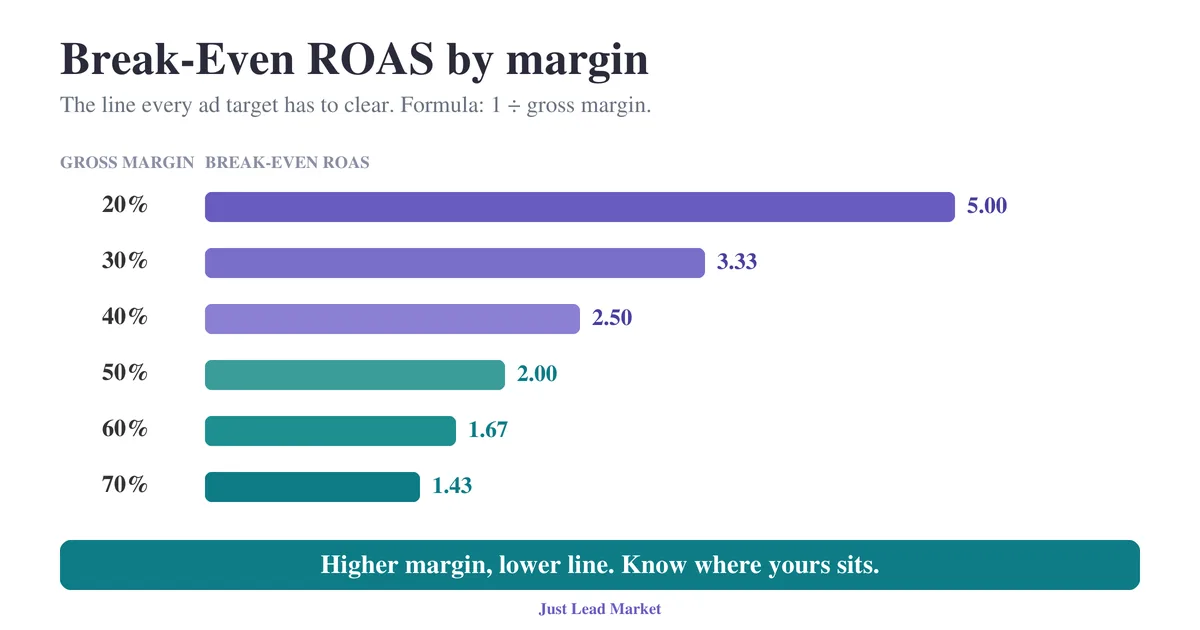
The basket decides it. At a $4 click and a 2.5 break-even ROAS, each click must return $10 of revenue. On a $40 order that needs a 25% conversion rate, on a $200 order 5%, on a $600 order 1.7%. Against the paper's 0.37% paid conversion rate, only the $600 order is in sight of its line without a repeat-purchase case behind it.
Is your store a candidate? Five signals and three stop signs
Go when all five hold. Your Shopping and Performance Max campaigns for the SKUs you would advertise already clear break-even ROAS by conversion time, read over a trailing four weeks. Your order value is above $150, or you have measured a repeat-purchase window that funds a first order below the line. Your category is one a buyer asks questions about: bedding, furniture, skincare, supplements, pet health, home improvement. Your tracking passes a clean audit, meaning the Conversions API and the pixel deduplicate against each other and every ad URL carries a UTM. And the owner accepts the first six weeks as a learning cost with a fixed cap.
Stop when any of these holds. Shopping for the same SKUs sits below its line, because a weaker channel will not fix a stronger one. Gross margin is under 35% or order value under $60, because the click cannot pay at any realistic conversion rate. Or the store has no server-side tracking, because the test will be judged on numbers nobody can reconcile.
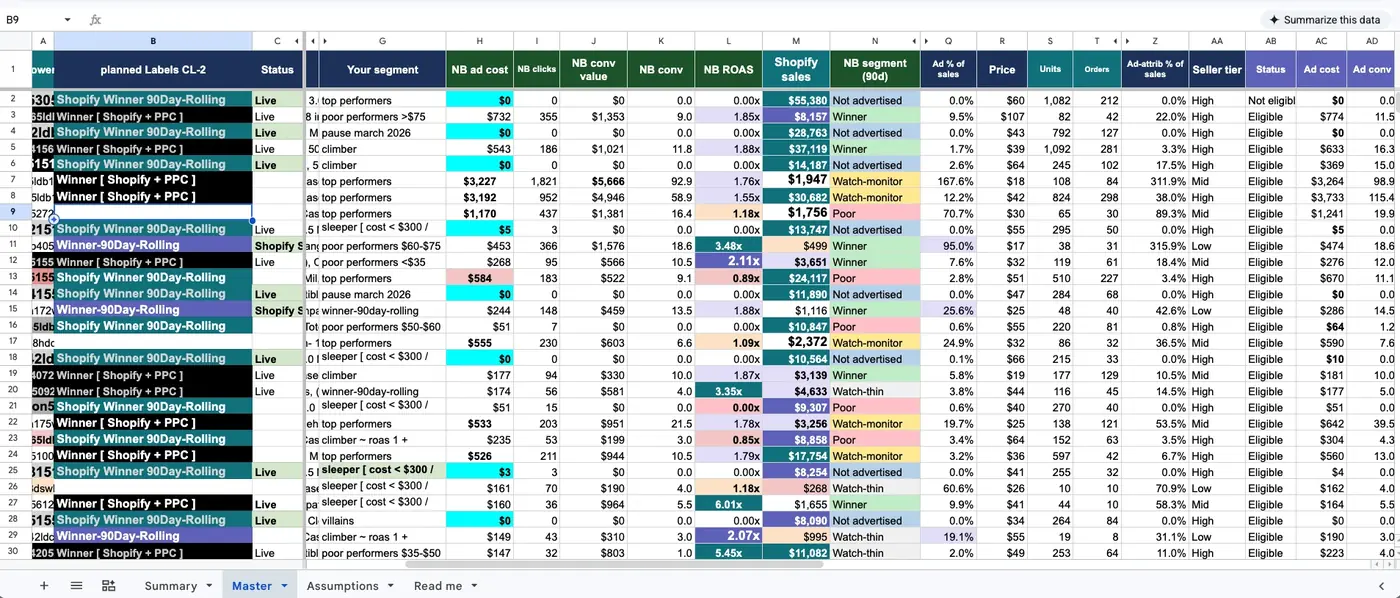
How to confirm you are reading your own account correctly before you decide: pull the Shopping and PMax campaigns for the candidate SKUs for the last four weeks with the Conv. value (by conv. time) column, divide by cost, and compare with 1 divided by gross margin. The break-even ROAS guide has the margin table. If that number is below the line, this page's answer for you is no, for now.
Where ChatGPT ad tests go wrong, in the order it happens
Ranked by how much budget each one burns before anyone notices, from the public evidence and the accounts we have run.
- Judging ROAS on a budget that cannot produce orders. $1,000 at a $4 click is 250 clicks. At the paper's 0.37% paid conversion rate that is 0.9 orders; even at Opascope's 2.35% it is 6. A zero-order month at that budget is the base case, not a verdict. Decide in advance what a small budget may prove (click-through rate, add-to-cart rate, landing engagement) and what it may not (ROAS).
- Double counting against Google and Meta. Google Ads claims an order against any Shopping click in its 30-day click window. The OpenAI pixel claims the same order on its own window. A customer who clicked both is counted twice in the platforms and once in Shopify. Judged platform by platform, the ChatGPT test and the Shopping campaign beside it both look better than the bank balance. The Shopify analytics versus Google Analytics guide covers why the store's own order record is the referee.
- Context hints written like keywords. "Memory foam mattress queen" is a search term. A context hint is "someone comparing mattresses for back pain who is asking how firm to go". OpenAI matches on conversation context and also reads your landing page, headline and copy; it does not match exact phrases. SE Ranking found 14.35% of ChatGPT ads were off-topic for the prompt that triggered them, and Adthena observed a negative phrases field in Ads Manager before OpenAI documented it. Write hints as conversations, and exclude your own brand name so you pay for new demand rather than for people already asking for you.
- Buying impressions when the job is orders. A $25 CPM at a 0.73% click-through rate is $3.42 a click; a $60 CPM is $8.22. OpenAI's suggested $3 to $5 CPC bid is the cheaper buy unless your creative clears twice the market click rate, and conversion-optimized bidding, which OpenAI began rolling out on June 5, is the only objective that bids toward the number you care about. Automated bidding arrived preselected in new ad groups in August; check the setting before launch.
- Launching the feed campaign on the whole catalog. With one slot per answer, a feed campaign pushes whichever product the matching system finds most relevant, and on a 400-SKU catalog that is often a low-margin accessory. Put your Hero SKUs in the feed campaign and nothing else; the rest of the catalog can wait for a second test.
- Reading the result before the conversion lag clears, and never reading the organic channel. Research-stage clicks convert late. Give the final read a seven-day lag. Then read the organic AI Assistant channel in GA4 for the same weeks: Kaiser and Schulze estimated a 6% to 8% fall in organic ChatGPT referrals after ads launched in a market, so a test that lifts paid sessions while organic referrals slide has not added anything.
- UK and EEA consent defaults. Automatic advanced matching, which sends hashed customer information from website forms, became the default on existing OpenAI web pixels on August 17, 2026 (PPC Land), and OpenAI's documentation says the pixel initializes consent as true unless your setup tells it otherwise. For a UK store that is your lawful-basis problem, not OpenAI's. Wire consent before the pixel goes live.
How to test ChatGPT ads against Google Shopping: the budget, the tracking, the kill rule
This is the test we run for a store at $10,000 a month and above. It is designed so a store at $10,000 learns something it can act on and a store at $50,000 can read a ROAS.
- Set the line. The test campaign carries the same break-even ROAS as the Shopping campaign for the same SKUs: 1 divided by gross margin on those products. Nothing on the page below changes that number.
- Pick the SKUs. Hero products only, meaning the SKUs that already clear their line on Shopping with the most contribution, 10 to 30 of them, order value above $150 where you have it. If you run our Hero, Sidekick, Ghost labeling, this is the Hero list.
- Pass the tracking gate before a dollar is spent. Install the pixel and the Conversions API through the ChatGPT Ads app for Shopify or through GTM, and confirm that a test purchase arrives once, not twice, with the same event ID on both paths. Append utm_source=chatgpt.com and utm_medium=cpc to every ad URL, which is the pair the Kaiser and Schulze panel saw on paid clicks, plus a campaign name. Build a GA4 segment on that pair; the referrer-based AI Assistant channel will not catch paid clicks.
- Fix the budget and the clock. 5 to 10% of the Google Ads budget, held flat for 42 days, and never topped up. The table below is the reading each band can support.
- Buy clicks, not impressions. Clicks objective, a $3 to $4 maximum bid, the catalog-fed card where it is offered, five to ten context hints per ad group written as conversations, your brand name excluded.
- Read twice. Day 14: click-through rate against the 0.73% US and 0.74% UK market rate, and add-to-cart rate against the Shopping campaign for the same SKUs. Day 49 (day 42 plus the lag): tracked Shopify orders with a ChatGPT UTM, the OpenAI-reported conversions beside them, and the Google-claimed orders for the same customers, reconciled to one count.
- Decide with the rule. Apply the kill rule below in order and write the decision down.
| Google Ads budget | Test budget, 42 days | Clicks at $4 | Orders at 0.4% and at 2% conversion | What the test can read |
|---|---|---|---|---|
| $10,000 a month | $1,050 to $1,400 (the reported $25 a day floor sets the low end) | 260 to 350 | 1 to 7 | Click-through rate, landing engagement, add-to-cart rate. Not ROAS |
| $25,000 a month | $1,750 to $3,500 | 440 to 875 | 2 to 18 | An early cost-per-order signal only if conversion lands near 2% |
| $50,000 a month | $3,500 to $7,000 | 875 to 1,750 | 4 to 35 | A ROAS read with meaning, if 20 or more orders arrive |
| £5,000 a month (UK) | £350 to £700, subject to the daily minimum in your billing currency | 90 to 175 at £4 | 0 to 4 | Click-through rate and engagement only |
The kill rule, applied in this order:
- Day 14, click-through rate under 0.5% after one creative and context-hint refresh: kill. The channel's matching is not finding your buyer.
- Day 14, add-to-cart rate from ChatGPT sessions under half the Shopping rate for the same SKUs: kill.
- Day 49, cost per tracked Shopify order more than 50% above the SKU set's break-even line, or fewer than 10 orders: kill, or move it to the capped awareness lane described below.
- Day 49, at or below the line with 20 or more orders: scale in 25% monthly steps, never above 15% of the Google Ads budget until a 90-day MER read confirms the blend improved.
- Any day the spend cap is reached: stop. "It needs more time" is how a test becomes a line item.
- Any week organic AI Assistant sessions fall more than 10% against the six weeks before the test while ads run: pause, and compare your context hints with the prompts that cite you organically before resuming.
The awareness lane is a brand decision, and it should be made on purpose. A store with a long view that sees market-rate click-through, solid engagement and orders below the line can hold ChatGPT ads at a fixed 3% to 5% of budget as a research-stage placement, funded from the awareness line of its budget map and never from Shopping's allocation. Write the cap down and review it quarterly against the organic AI channel, which is where the return is most likely to show up.
What breaks differently at $50,000 a month. The claimed-order problem triples: Google, Meta and OpenAI each claim the same customers, so the blended MER guardrail decides whether total spend moves, and platform ROAS only decides where. Several feed campaigns need the same SKU tiering as your Shopping campaigns or they bid against each other for one slot. At this volume the pixel has enough events to build custom audiences, which is the point to run a second test that separates new customers from returning ones in the read. And every advertiser has its own Ads Manager account with no manager-account layer, so the store owns the account and invites the agency, which is the ownership rule we hold on Google Ads as well.
Honest note on DIY. At $10,000 to $25,000 a month, a founder can run this test from the Shopify app in an afternoon and read it on day 14 and day 49 without help; the rule above is the whole method. DIY stops making sense when the read has to reconcile three platforms' claimed orders against Shopify, tier the catalog across several feed campaigns, and decide budget moves against break-even lines every week. On accounts above $25,000 a month that is the job, and reading a ChatGPT test wrong costs more than the fee.
What getting it wrong costs
Arithmetic with round numbers, not client results.
Running on impressions without a cap. A store spending $30,000 a month on Google Ads puts 10%, $3,000 a month, into an impressions campaign at a $40 CPM. That buys 75,000 impressions. At the market click-through rate of 0.73%, 548 clicks, an effective $5.47 each. At the paper's 0.37% paid conversion rate, 2 orders at $150: $300 of revenue, a 0.10 ROAS. Six months of that is $18,000 spent for $1,800 of revenue and about $720 of gross profit at a 40% margin, a cash loss near $17,000. The same $18,000 left in a Shopping campaign at its 2.5 break-even line returns $45,000 of revenue and the spend back.
Never testing while the organic channel grows. The cost is smaller and slower, and it is not lost orders today. Organic ChatGPT referrals reached 0.40% of visits in the Kaiser and Schulze panel's final four weeks, at a conversion rate that matched organic search before the rollout and did not move after it. A store that never tests arrives at the point where that share matters with no data on what its buyers ask, which context hints trigger its products, and what a tracked order costs. The capped test is the cheapest way to buy that learning.
How JLM runs it: the BE-ROAS Budget Map and Hero, Sidekick, Ghost
Two frameworks do the work. The BE-ROAS Budget Map gives every campaign its own break-even line by margin band, and a ChatGPT test campaign enters the map as its own line, funded from the awareness allocation, never carved out of a Shopping campaign that is clearing its line. Hero, Sidekick, Ghost decides what goes in the feed campaign: Hero products only, because one slot per answer is too few to spend on anything else. The test then runs on the weekly read we use for every campaign, by conversion time, against the line. The full method is on our ecommerce PPC management page, and the Shopping side of the comparison on our Google Shopping agency page.
Measurement comes first. Before any ChatGPT campaign goes live on a client account, the pixel and Conversions API go through the same 55-check tracking audit we run on Google Ads conversions, with the deduplication test and a consent read for UK and EEA traffic.
Sources and methods: OpenAI's help center ("Ads in ChatGPT", read 2026-11-05) for who sees ads, labeling, the EEA and Switzerland personalization note and data handling. OpenAI's announcements of May 5 (self-serve Ads Manager, CPC bidding, pixel and Conversions API), August 31 ($1 billion annualized run rate) and October 21, 2026 (89 countries, 100,000 advertisers), as reported by PPC Land, which also quotes the ad unit specification, objectives, suggested bids and auction design from OpenAI's help documentation. Search Engine Land (August 2026) for product feed campaigns, conversion-optimized bidding and the carousel test. The Shopify App Store listing for the ChatGPT Ads app, read 2026-11-09. Adthena (August 21, 2026) and SE Ranking (July 2026, 50,006 commercial prompts), via PPC Land and Search Engine Land. Similarweb and Graphite, "The State of ChatGPT Ads" (September 28, 2026), via PPC Land. Kaiser and Schulze, "Can Advertising Fund Free AI?" (October 2026, version 1, under review), via PPC Land (November 2, 2026). The cost section is arithmetic with round numbers, not a client result.
ChatGPT ads for ecommerce: facts
| Field | Value |
|---|---|
| Topic | ChatGPT ads for ecommerce stores: cost, audience, and a test against Google Shopping |
| Who sees ChatGPT ads | Free and Go plan users; Plus, Pro, Business, Enterprise and Edu accounts never; no ads to accounts identified as under 18 (OpenAI help center) |
| Ad unit | One labeled sponsored card below the answer; 1.06 ad items per ad-bearing US answer (Adthena, March to May 2026) |
| How often | 25.94% of 50,006 commercial US prompts (SE Ranking, July 2026) |
| Price | OpenAI's suggested starting maximum CPC $3 to $5; default maximum CPM $60; no account minimum since May 5, 2026 |
| Click-through rate | 0.73% US, 0.74% UK, March 30 to September 16, 2026 (Similarweb and Graphite) |
| What a paid click returns | $0.89 revenue per paid ChatGPT visit against $2.45 per paid Google Search visit, US traffic (Kaiser and Schulze, October 2026) |
| Availability | 89 countries as of October 21, 2026; US since February 9, UK since June, 31 European markets since August 24 |
| Test rule | 5 to 10% of the Google Ads budget, 42 days, Hero SKUs only, tracked Shopify orders against the SKU set's break-even ROAS, hard spend cap |
| Last updated | 2026-11-09 |
Find out whether your Shopping account can afford the test
The Just Free Audit reads every Shopping and Performance Max campaign against its break-even ROAS by conversion time, and checks the tracking a ChatGPT test depends on. If Shopping is below its line, you get that finding first, and the ChatGPT question answers itself for now. You get the report whether or not you hire us. It is the same 78-point Google Ads audit we sell for $199, run free for stores at the spend level where a test is affordable.