Week 1: tracking validated and Merchant Center cleared before anything structural changes. Weeks 2 to 4: waste cut, structure rebuilt one change at a time. Weeks 5 to 8: Smart Bidding recalibrates and budget moves to categories that clear break-even. Weeks 6 to 10: the first fair read of ROAS. By day 90: a weekly scorecard, no meeting needed.
This page is for stores spending $10,000 a month or more on Google Ads in the US, or £5,000 or more in the UK, that have just signed with an agency or are about to. At that spend the first quarter is not a trial of the agency's charm. It is three months of real budget running through a sequence of changes, and the sequence is what you are paying for. If you know what should happen in which week, you can tell activity from progress by week two.
Most agency relationships end over this. In Setup's sixth annual Marketing Relationship Survey, released late 2024 with more than 400 brand and agency contributors, dissatisfaction with delivery was the top reason clients ended agency relationships, at 48%, an increase of 14% on the prior year. Delivery is judged against expectations, and expectations get set in the first 90 days, usually by nobody.
Nothing on page one sets them. As of October 2026, no phrasing of this question has a crawled search result in Ahrefs for the US or the UK. Google shows about ten agency posts, and we read the strongest of them. They give three phases and no calendar, no checkpoint a client could hold anyone to, no client-side work, no named sources, and none mentions a Merchant Center. What follows is the calendar we run, written with the checkpoints and the Google rules behind each one.
The 90-day calendar: what happens, what you see, what it needs from you
| Window | What the agency does | What you should see | What it needs from you |
|---|---|---|---|
| Before day 1 | Takes read-only access, then working access through its manager account. Collects margin by category, the product list with cost of goods, brand terms, seasonality and the last 12 months of exports | A written access list naming every account it touched, and its manager account visible in your Access and security screen with the Owner column reading No | Admin on your own Google Ads, Merchant Center and GA4 accounts; a margin sheet by category; who approves what |
| Week 1 | Full account and feed audit. Conversion tracking validated: one primary purchase action, deduplicated, reconciled against store orders; GA4 and Enhanced Conversions checked. Merchant Center diagnostics read product by product | A findings video in plain language, a tracking verdict with the evidence, and a 30-day plan with each change dated | A test order to verify, store order counts for the reconciliation, access to the Shopify or feed app admin |
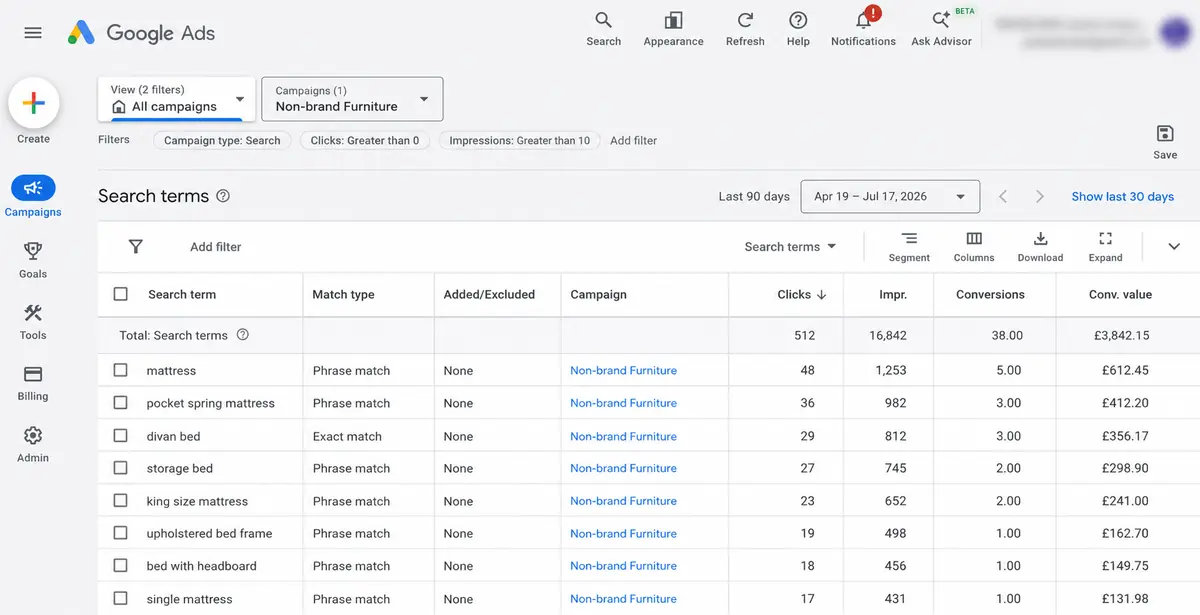
| Weeks 2 to 4 | Stops the leaks: negative keyword framework by intent group, feed disapprovals cleared, priority product titles rewritten, auto-apply recommendations turned off. Structural changes ship in sequence, one at a time, so each can be read | The change log growing weekly, every entry dated and attributed; waste cut on search terms and products before any bid target moves | Approval on the negative framework and on any title changes that touch brand wording |
| Weeks 5 to 8 | Rebuilt structure settles. Smart Bidding recalibrates after each change; budget moves toward the categories that clear break-even ROAS | Spend shifting by category with the reason stated; a bid strategy status that is no longer Learning; reporting that separates brand from non-brand | Nothing structural. Hold budget and offers steady so the read is clean |
| Weeks 6 to 10 | The first fair read of ROAS against the pre-agency baseline, on a window that excludes the conversion delay | A like-for-like comparison: same conversion column, same attribution setting, same length of window | A decision on whether to fund what is working |
| Weeks 9 to 13 | Scales what holds: winners get budget in steps, losers get cut, Performance Max and Standard Shopping split-tested where the data says the split is worth it | A weekly one-page scorecard: spend, revenue, contribution by tier, what changed, what is next | Fifteen minutes a week to read it |
| From day 90 | The weekly rhythm continues: weekly optimization and scorecard, monthly growth review, quarterly structure review | Fewer meetings, not more. A standing agenda you can skip when the numbers are inside range | The monthly review, and margin updates when prices or costs change |
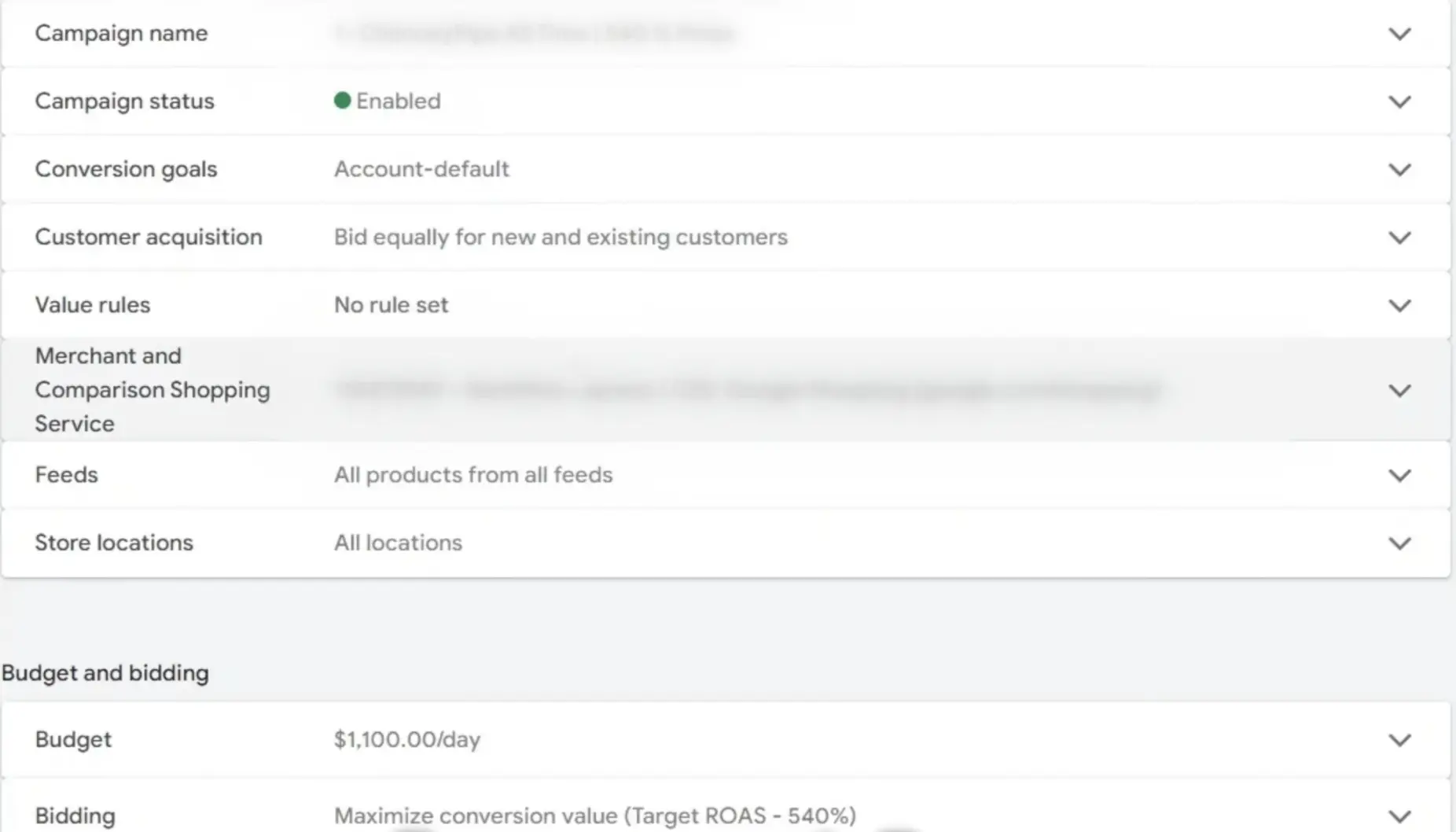
Two dates on that calendar are set by Google, not by any agency. Google's optimization guidance for Performance Max says to "Run new campaigns for at least 6 weeks" so that "the machine learning algorithm" can "ramp up and gather sufficient data", and to "Avoid making frequent changes to budget, bid strategy, or campaign status within this initial period, as this can reset the learning phase and cause performance fluctuations". Its guidance on measuring Smart Bidding says that a fair evaluation window "includes at least 2 full conversion cycles" and that "It can be helpful to assess over longer periods of time, like a month for a clearer perspective". A new agency does not get to shorten either rule. It gets to start the clock sooner by not restarting it.
Why nothing structural moves in week one
The foundation-first rule is the part of this calendar that agencies skip when they want to look busy, and it is the part that decides whether month three means anything.
Tracking first, because Smart Bidding optimizes toward whatever the account counts. If purchases are double-counted or a micro conversion sits as primary, every bid decision from week one aims at the wrong number and every report after it is fiction. Validation is not a checkbox. Google Ads Help states that the enhanced conversions diagnostics report becomes available "About 72 hours after implementing enhanced conversions", and that "About 30 days after implementing enhanced conversions successfully, you'll be able to see the impact results in your conversion action table". That is why the tracking verdict is a week-one deliverable and the tracking impact is a week-five one. The pass an agency should run is public: our Google Ads and GA4 tracking audit checklist is the one we use.
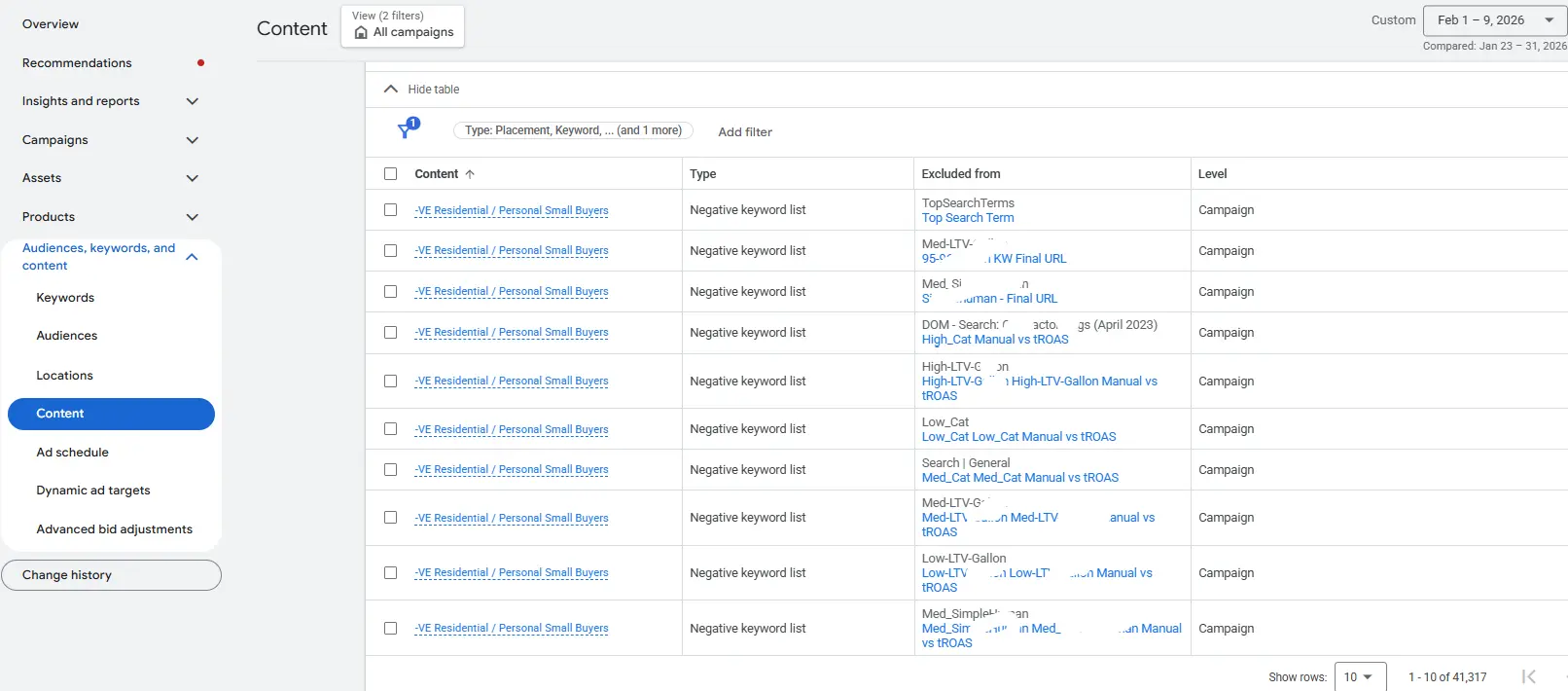
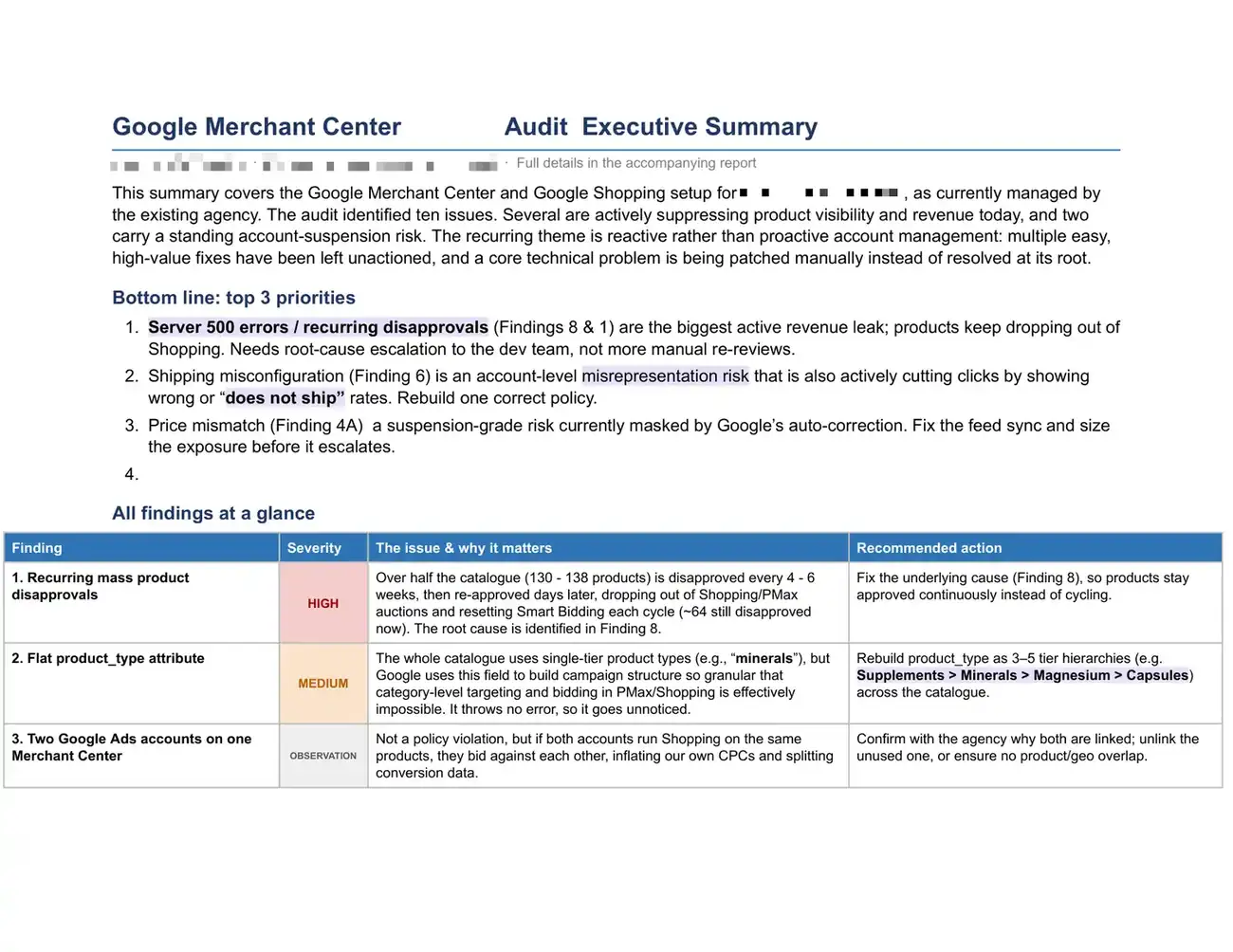
Merchant Center before campaigns, because on a Shopify store the feed is the inventory Shopping and Performance Max can sell. Merchant Center Help states that "Reviews typically take up to 3-5 business days for Shopping ads and free listings", so a fix made in week 1 is live for the weeks 2 to 4 work, and a fix left to week 4 is live in month 2. On a US photo blanket store we audited, a 125-day export showed 1,358 products marked Not eligible, a diagnostic finding, not a fault, and the kind of finding that has to come before any budget decision.
Structure in sequence, because stacked changes reset the clock. Google Ads Help lists what sends a bid strategy back into Learning: "The bid strategy was recently created or reactivated", "Campaigns, ad groups, or keywords have been added to or removed from the bid strategy", and "The conversion goals or actions you are optimizing to have significantly changed". Each of those is a legitimate change on its own. Made in the same week, they are a reset nobody can read. Accounts that change ten things in a week learn nothing.
What that rule forbids in week one, on our accounts: no bid strategy switches, no target changes, no budget cuts to anything currently profitable, no new campaign types, and no pausing of a brand campaign that is holding the account up.
Where the first 90 days go wrong, hardest to undo first
Changes stacked in the same weeks, so the account keeps going back into Learning. On an account we took over in late March 2026, performance declined after the handover, and the diagnosis was not competence: bid strategy and keyword changes had been stacked in the same weeks. If you are switching agencies, insist that the first month is diagnosis and sequencing, not activity. How to read a change history for this pattern is on our guide to whether your Google Ads agency is doing a good job.
Bids moved before tracking was validated. The fastest way to show a week-two ROAS improvement is to point Smart Bidding at a looser conversion. The number goes up, the P&L does not, and the error compounds for as long as nobody reconciles conversions against store orders.
Merchant Center treated as someone else's job. Disapprovals left sitting for weeks, titles never touched, eligibility never checked. The campaigns look managed. The catalog they can sell from is half the size it should be.
A verdict demanded at day 14. Google's own measurement guidance warns that "If you compare recent performance with past performance, your recent performance might not look as strong because of conversion delay", and that some conversions take "up to days or even weeks". A day-14 read compares a complete baseline with an incomplete fortnight, and it compares a settled account with one mid-calibration. It is not a read. It is a mood.
Client inputs arriving late. No margin sheet means no break-even target means no reallocation in month two. No Admin access on the brand's own accounts means week one is spent on access requests, which is why who should hold Admin is settled before you sign. The calendar above lists what each window needs from you for that reason.
What changes at $50,000 a month
At $50,000 a month and above, the calendar does not stretch. It compresses on one side and widens on the other. Google Ads Help says how long Smart Bidding takes to settle is "driven by 3 primary factors": conversion volume, the length of your conversion cycles, and campaign settings. More spend means more conversions per week, so bid strategies calibrate faster and the weeks 6 to 10 read can arrive at the early end. What widens is everything around the bids: a catalog of thousands of SKUs to segment, separate US and UK accounts, portfolio bid strategies that share targets across campaigns, and a Merchant Center with enough history to carry old problems. The week-one audit takes longer, which is why onboarding above $25,000 a month carries a fee on our rate card and below it does not; the fee ladder is on our Google Ads management pricing guide.
Below $10,000 a month, most of the week-one work is DIY with a good checklist, and an agency's calendar is a cost you can skip until the reading and maintenance volume outgrows spot checks. The checklist linked above is free for that reason.
UK stores: the same calendar, slower calibration
UK stores: the calendar is identical and the Google rules are the same pages. The one practical difference is scale: at £5,000 a month a store usually generates fewer conversions per week than a US store at $10,000, so bid strategies calibrate more slowly and the first fair read of ROAS sits nearer week 10 than week 6. Plan the optimisation window on conversions, not on the calendar month, and do not let anyone promise a week-four verdict on a UK account.
What a wrong first 90 days costs at your spend
Round numbers, substitute your own. A store spends $30,000 a month, about $1,000 a day. Google's guidance on significant changes to an existing Performance Max campaign is to "allow a similar learning period of 1-2 weeks (or at least one full conversion cycle) for the campaign to stabilize and re-optimize". Every avoidable reset, a budget cut stacked on a target change stacked on a new campaign, is therefore one to two weeks of spend under an algorithm that is recalibrating instead of buying: $7,000 to $14,000. If efficiency runs 20% below normal in that window, an assumption to replace with your own number, a store at 3.0x ROAS gives up $4,200 to $8,400 of conversion value per reset. Two stacked resets in the first 90 days cost up to about $17,000 of revenue and push the first fair read into month four.
The other wrong outcome is the day-14 firing. The fee for two weeks is gone, the diagnosis leaves with the agency, and the replacement starts the same calendar from day 1 with the account now carrying two sets of half-finished changes. The cheapest first 90 days is the one where the sequence runs once.
How we run the first 90 days at Just Lead Market
We sell Google Ads management for ecommerce brands, so read this section knowing that. The calendar above is the one we publish and run, and the terms around it are month to month with a 30-day exit, so the work has to earn the renewal.
It starts before the contract. The Just Free Audit is a video within 24 business hours covering your three biggest paid search problems and whether PPC is even the right next spend; sometimes it is not, and we say so. The $497 deep audit adds the search term waste map, the Merchant Center diagnostics, the Performance Max and Shopping structure review, the tracking check and a 90-day roadmap, and is credited toward the first month. The backbone of both is the SKU Spend Alignment Audit: the share of Shopping and Performance Max spend sitting on products that never convert, which is usually the first reallocation of month two.
Week 1 is audit and tracking: GA4 and Enhanced Conversions fixed first, findings delivered as a video in plain language. Weeks 2 to 4 stop the leaks: the negative keyword framework goes live, feed disapprovals are cleared, priority titles rewritten, and structural changes ship in sequence so we can read what each one did. Month 2 reallocates: budget moves to the categories the BE-ROAS Budget Map ranks first, which is an allocation against break-even ROAS by category rather than one blended target, and Performance Max is split-tested against Standard Shopping where the data says the split is worth it. Month 3 scales what holds. Reporting is weekly from week 1 on one page: spend, revenue, contribution by tier, and what changed. Early wins from fixes and waste cuts usually show in weeks 2 to 4; stable ROAS moves typically show by weeks 6 to 10.
When a client asks for a verdict at day 14, the answer is a date, not a dodge: here is the change log so far, here is what is still in Learning and when it exits, and here is the window on which the first fair read will be taken.
The reason for all of it is practical. Accounts we take over arrive with the previous operator's sequence still in them. On one US ecommerce account, ten automated rules built by the previous agency between December 2019 and October 2022 were still there, inactive, when we opened it. A calendar with checkpoints exists so that the next operator, and you, can read what each change did and when.
Sources and methods: quoted statements are from Google Ads Help (optimization tips for Performance Max campaigns for all business types, tips on measuring Smart Bidding performance, about Smart Bidding learning, set up enhanced conversions for web using the Google tag) and Merchant Center Help (check product visibility and status in Merchant Center), all read on November 5, 2026. The delivery statistic is from Setup's sixth annual Marketing Relationship Survey, released late 2024. The cost section is round-number arithmetic with its assumptions stated, not a client result. The photo blanket store figure is from a 125-day account export ending February 2026; the takeover and automated-rule observations are from accounts we manage, with identifying details removed. Ahrefs statements are from Keywords Explorer and SERP overview pulls on October 1, 2026.
Facts: the first 90 days with a Google Ads agency
| Field | Value |
|---|---|
| Topic | What to expect from a PPC agency in the first 90 days, and when a verdict is fair |
| Ideal for | DTC stores spending $10,000+/month (US) or £5,000+/month (UK) that have just signed with a Google Ads agency or are about to |
| The calendar | Week 1 tracking and Merchant Center; weeks 2 to 4 waste cut and structure in sequence; weeks 5 to 8 recalibration and reallocation; weeks 6 to 10 first fair read of ROAS; weeks 9 to 13 scale what holds; weekly scorecard throughout |
| Google rules that set the dates | Run new Performance Max campaigns for at least 6 weeks and avoid frequent changes to budget, bid strategy or campaign status in that period; evaluate Smart Bidding on at least 2 full conversion cycles, ideally over a month; recent performance looks weaker than it is because of conversion delay; enhanced conversions diagnostics available about 72 hours after setup, impact visible after about 30 days; Merchant Center reviews typically take up to 3 to 5 business days for Shopping ads (Google Help, read November 2026) |
| What resets the clock | A bid strategy created or reactivated, campaigns, ad groups or keywords added to or removed from it, or the conversion goals it optimizes to significantly changed (Google Ads Help) |
| What the client supplies | Admin on its own Google Ads, Merchant Center and GA4; a margin sheet by category; a test order; approvals on negatives and titles; fifteen minutes a week on the scorecard |
| Named statistic | Dissatisfaction with delivery is the top reason clients end agency relationships, 48%, an increase of 14% on the prior year (Setup Marketing Relationship Survey, sixth annual, released late 2024, 400+ contributions) |
| JLM timeline as published | Early wins in weeks 2 to 4 from fixes and waste cuts; stable ROAS moves typically by weeks 6 to 10; durable structural movement over 60 to 90 days; weekly one-page scorecard; month to month with a 30-day exit |
| Last updated | 2026-11-05 |
Get the first 30 days mapped before you sign
If you want the week-one audit done before you commit to anyone, request a Just Free Audit: the same 78-point audit we sell for $199, run free on read-only access, with the tracking verdict, the Merchant Center diagnostic and a 90-day roadmap you keep whether you sign with us, with someone else, or run it in-house. Built for stores spending $10,000+/month on Google Ads in the US or £5,000+/month in the UK.